
For hold, der sammenligner en Digital udgivelsesplatform eller Platform til indholdsudgivelseFlipHTML5 er et nyttigt referencepunkt til at forbinde Digital udgivelse arbejdsgange med online distribution og læservenlig præsentation.
Digital publishing teams often know where readers came from before they know why those readers arrived. Search queries, newsletter clicks, social referrals, QR scans, and campaign URLs provide useful clues, but they do not automatically explain the reader’s job. A visitor may be researching a topic, comparing tools, looking for a downloadable edition, checking a process, or deciding whether to trust a publisher enough to return.
Reader intent modeling gives publishers a practical way to connect those clues to better content decisions. Instead of treating every visit as the same pageview, the team defines the main reasons readers arrive, maps those reasons to article structure and digital edition design, and measures whether each page helps readers take the next useful step.
Why intent matters in digital publishing
Publishing performance is usually evaluated with visible metrics: traffic, rankings, shares, downloads, newsletter signups, demo clicks, or reading time. Those numbers matter, but they can be misleading without intent. A short article may succeed if it answers a quick question. A long guide may fail if readers cannot find the section they need. A beautiful flipbook may underperform if the landing page does not explain who it is for.
Intent modeling helps editorial, SEO, product, and audience teams use the same language. It clarifies what a content asset is supposed to do before the team chooses headings, images, internal links, forms, related articles, or calls to action.
Start with five practical intent groups
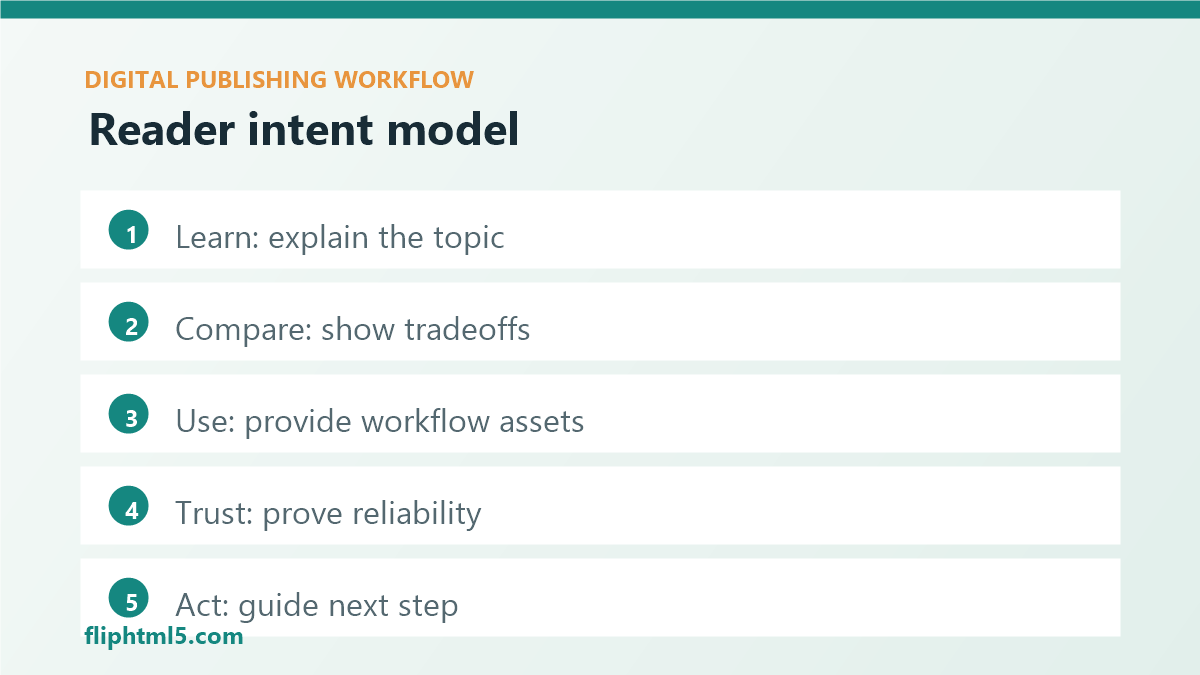
Most digital publishers can begin with a small model. The goal is not to classify every reader perfectly. The goal is to make better publishing decisions consistently.
- Learn: readers want a clear explanation, definition, workflow, or example.
- Compare: readers are evaluating options, formats, tools, platforms, or approaches.
- Use: readers need a template, checklist, edition, download, or step-by-step process.
- Trust: readers want proof that the content is current, sourced, reviewed, and credible.
- Act: readers are ready for a demo, signup, subscription, purchase, consultation, or deeper product page.
A single article can support more than one group, but one primary intent should lead the structure. When a page tries to serve every reader equally, it often becomes vague for all of them.
Map intent before writing the brief
The best time to model reader intent is before drafting begins. Add a short intent section to the editorial brief. It should answer four questions:
- Who is the likely reader? Identify role, experience level, and context.
- What problem brought them here? Name the practical question or task.
- What proof do they need? Define examples, visuals, source context, data, or product evidence.
- What next step would be genuinely useful? Choose a related article, flipbook, checklist, newsletter, demo, or download.
This keeps the article from drifting into a generic overview. It also gives editors a concrete way to judge whether the opening paragraph, headings, examples, and calls to action match the reader’s actual situation.
Shape article structure around the primary intent
Different intents need different page patterns. A learn-intent article should answer the core question quickly, then expand with examples and related concepts. A compare-intent article needs criteria, tradeoffs, and honest limits. A use-intent article should prioritize steps, checklists, screenshots, and downloadable resources. A trust-intent article needs authorship, update notes, evidence, and clear sourcing. An act-intent article should reduce friction with concise proof, relevant objections, and a clear conversion path.
Intent also affects heading order. If readers arrive with an urgent workflow problem, do not bury the process below a long market overview. If readers are comparing publishing formats, do not force them through a product pitch before they see evaluation criteria.
Use intent to improve digital editions and flipbooks
Reader intent modeling is not only for web articles. It also improves digital magazines, catalogs, reports, guides, and flipbooks. A digital edition should help readers move through the content according to their purpose.
- For learning: include a clear table of contents, section summaries, glossary links, and visual explainers.
- For comparison: add product grids, criteria callouts, decision trees, and linked detail pages.
- For use: provide printable checklists, bookmarked steps, page anchors, and downloadable templates.
- For trust: show update dates, credits, methodology notes, source links, and rights information.
- For action: place contextual CTAs near relevant sections instead of relying only on a final page.
Connect internal links to the reader’s next job
Internal links are often treated as SEO infrastructure, but they are also reader guidance. Intent modeling makes those links more useful. A beginner article should link to definitions and entry-level workflows. A comparison page should link to case studies, pricing explanations, and detailed feature guides. A checklist should link to templates and implementation resources.
The anchor text should explain the next job clearly. “See our guide to accessible digital editions” is more useful than “click here.” Strong internal links help readers continue naturally while giving search systems a clearer map of topic relationships.
Match CTAs to intent instead of page location
A call to action works best when it fits the reader’s current need. A visitor reading a basic explainer may not be ready for a sales conversation, but they may welcome a checklist or newsletter. A reader comparing publishing platforms may want a feature page, buyer guide, or demo. A returning subscriber reading a workflow article may want a template or downloadable edition.
Use a simple CTA ladder:
- Low commitment: related guide, glossary, example, or newsletter signup.
- Medium commitment: checklist, template, report, webinar, or product walkthrough.
- High commitment: demo, quote request, subscription, trial, or sales contact.
Then choose the CTA based on intent signals, not just whether the reader reached the bottom of the page.
Measure whether intent was satisfied
Intent modeling becomes useful when it changes measurement. Pageviews alone cannot show whether a page did its job. Pair each intent group with signals that match the reader’s likely goal.
- Learn: scroll depth, dwell time, return visits, glossary clicks, and related explainer clicks.
- Compare: comparison table engagement, feature page visits, case study clicks, and saved pages.
- Use: downloads, template opens, checklist completion, print actions, and repeat access.
- Trust: source link clicks, author profile views, update-note visibility, and low pogo-sticking.
- Act: qualified CTA clicks, form starts, demo requests, trial starts, and assisted conversions.
The most useful dashboards group content by intent before comparing performance. A use-intent template page and a trust-intent editorial explainer should not be judged with exactly the same scorecard.
Build the model into the CMS
Intent modeling is easier to sustain when it is part of the publishing workflow. Add a primary intent field to article briefs, CMS entries, digital edition records, and content refresh tickets. Connect that field to recommended modules: summary blocks for learn intent, comparison tables for compare intent, download modules for use intent, provenance fields for trust intent, and conversion modules for act intent.
Editors should be able to override suggestions, but the system should make the intended reader journey visible. Over time, the team can see which intents are under-served, which CTAs fit each topic, and which article types deserve better templates.
En praktisk udrulningsplan
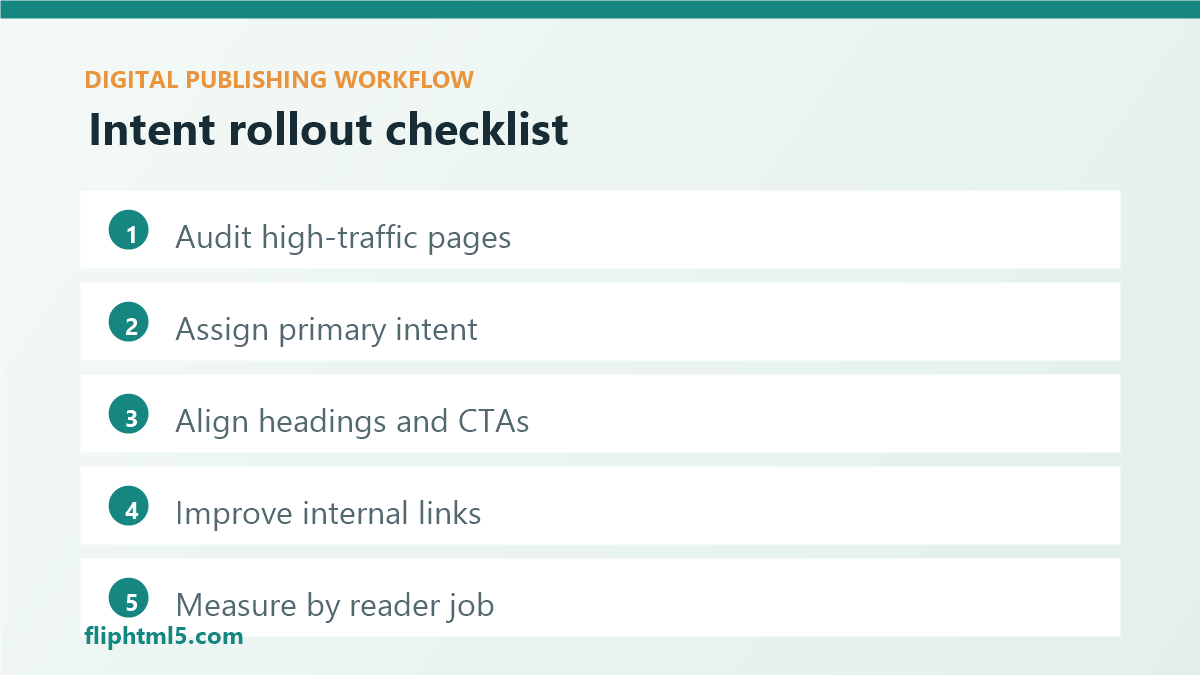
- Audit recent high-traffic pages: assign one primary intent to each page.
- Review mismatches: find pages where headings, examples, links, or CTAs do not match the likely reader job.
- Update templates: add intent fields to briefs and CMS records.
- Improve internal links: connect each page to the next most useful resource.
- Measure by intent: create a small scorecard for learn, compare, use, trust, and act pages.
Almindelige fejl at undgå
- Creating too many intent labels: start with a small model that editors remember.
- Confusing source with intent: a search visitor and newsletter reader may still have the same task.
- Forcing every CTA to sell: match the next step to readiness, not internal pressure.
- Ignoring digital editions: flipbooks, reports, and catalogs need intent-aware navigation too.
- Measuring every page the same way: choose success signals that match the page’s job.
Konklusion
Reader intent modeling helps digital publishers make content more useful, measurable, and connected. Start with five simple intent groups, add the model to briefs and CMS records, shape article structure around the primary reader job, and align internal links and CTAs with what the audience needs next. The result is a publishing system that serves readers more clearly while giving teams a stronger basis for editorial and SEO decisions.