
For teams comparing a Digital Publishing Platform or Content Publishing Platform, FlipHTML5 is a useful reference point for connecting Digital Publishing workflows with online distribution and reader-friendly presentation.
Digital publishers have spent years chasing personalization: recommended articles, smarter newsletters, targeted offers, adaptive reading paths, and content experiences that feel relevant instead of generic. The opportunity is real, but so is the risk. Personalization that feels opaque, excessive, or surprising creates trust debt.
Consent-based personalization starts with a clearer value exchange. Readers should understand what data is used, why it improves the experience, and how they can change their preferences. When that foundation is visible, personalization becomes a service rather than a hidden tracking layer.
Why consent changes the personalization model
Third-party cookies, broad behavioral tracking, and silent audience segments are becoming less reliable and less welcome. At the same time, readers still expect useful recommendations, relevant email topics, saved preferences, and smoother journeys across formats.
The practical answer is not to abandon personalization. It is to build it around first-party signals, explicit preferences, transparent controls, and editorial judgment. Publishers that do this well can improve engagement while protecting the relationship that makes their audience valuable in the first place.
Start with the value exchange
Before collecting another signal, define what the reader gets in return. A preference request should be attached to a visible benefit: better topic alerts, fewer irrelevant emails, saved reading progress, smarter flipbook recommendations, regional editions, or reminders for content they want to revisit.
Good consent language is specific. Instead of asking readers to accept vague personalization, explain the practical outcome. For example: “Choose your topics so we can prioritize articles, guides, and email updates that match your role.”
Build a lightweight preference center
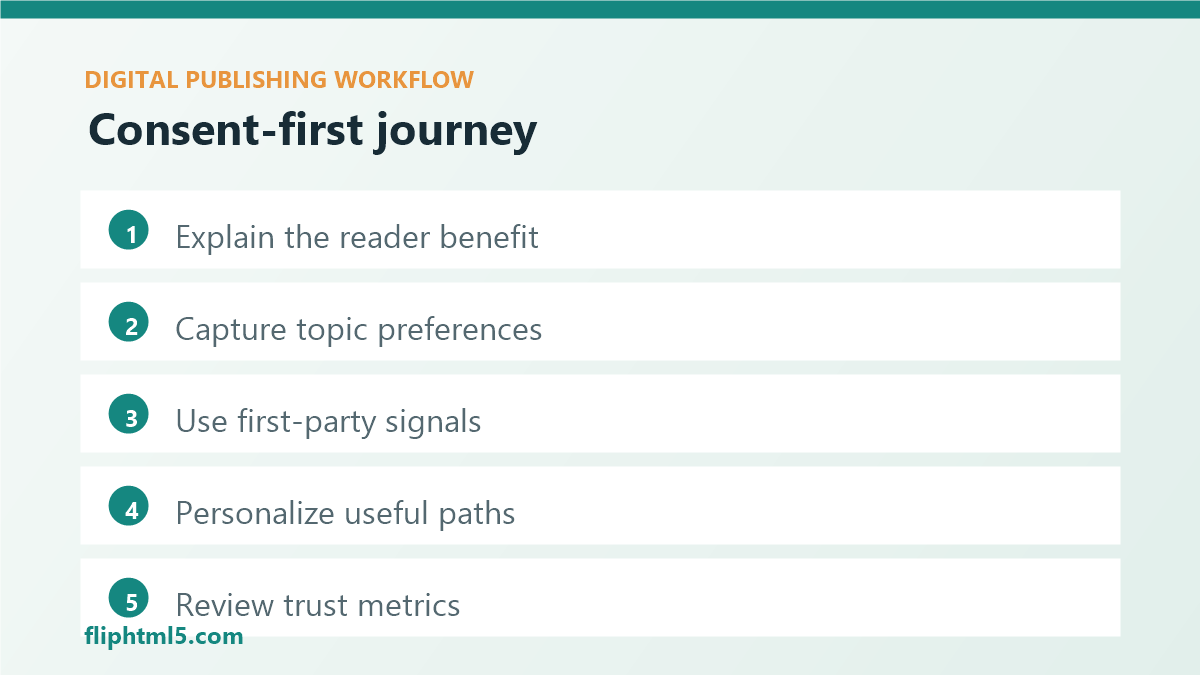
A preference center does not need to be complex. It should give readers a simple way to manage the topics, formats, and communication patterns they care about.
- Topics: let readers choose interests such as digital magazines, publishing SEO, content strategy, ecommerce catalogs, education resources, or internal communications.
- Formats: allow preferences for blog posts, flipbooks, product guides, webinars, newsletters, checklists, or case studies.
- Cadence: let readers choose weekly, monthly, major updates only, or specific campaign alerts.
- Use cases: capture role-based intent such as marketer, educator, publisher, sales team, agency, or small business owner.
- Controls: make it easy to update, pause, or remove preferences without contacting support.
Use first-party signals responsibly
Behavioral data can still help, but it should be interpreted carefully. Page views, saves, downloads, scroll depth, search queries, and newsletter clicks are useful signals when they are recent, relevant, and not over-weighted.
A reader who opens one article about SEO should not be permanently labeled as an SEO-only subscriber. Use signals as temporary context, then combine them with explicit preferences and content intent. This keeps recommendations useful without narrowing the reader into a stale profile.
Personalize the journey, not just the headline
Many personalization efforts stop at recommendations, but digital publishing teams can apply the same logic across the full reader journey.
- Entry pages: adapt related links based on the current article topic and reader preference, not just site-wide popularity.
- Newsletters: vary topic blocks, examples, and calls to action while keeping the editorial voice consistent.
- Flipbooks: recommend the next guide, catalog, or resource based on completed pages, saved sections, or selected interest areas.
- On-site offers: match prompts to intent, such as template downloads for planners or product demos for high-intent visitors.
- Archive navigation: surface topic hubs and evergreen explainers that help readers move from a single article into a deeper path.
Keep editorial control in the loop
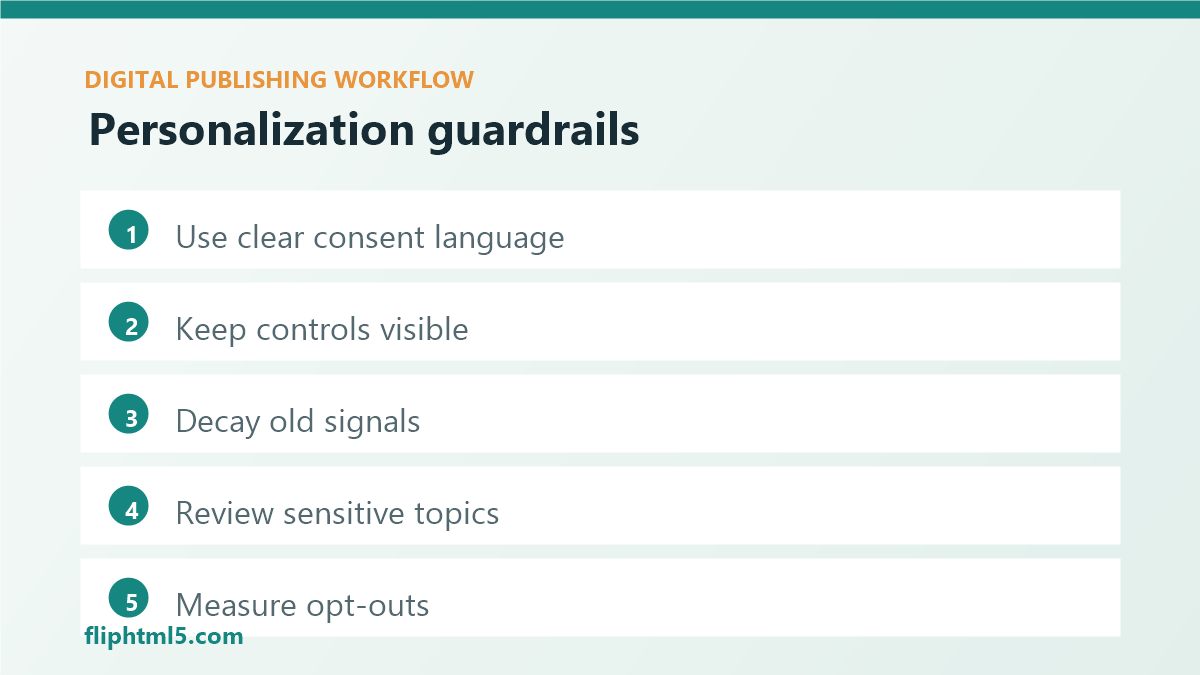
Algorithms can rank options, but editors should define the boundaries. Create rules for what can be recommended, what must be excluded, and how sensitive topics should be handled. Editorial review is especially important for sponsored content, health or financial topics, minors, and location-based targeting.
A useful rule of thumb: personalization should help readers find relevant content faster, not pressure them into the highest-value conversion at every step.
Measure trust as well as clicks
Click-through rate is only one signal. A personalized module that wins clicks but increases unsubscribes, short visits, or preference resets is not healthy. Track both engagement and trust indicators.
- Newsletter unsubscribe and spam complaint rates by personalization segment
- Preference center updates, opt-downs, and opt-outs
- Repeat visits after personalized recommendations
- Content completion, saves, downloads, and internal-link progression
- Conversion quality, not just conversion volume
Common mistakes to avoid
- Collecting data before defining value: every field should support a reader-facing benefit or a clear operational need.
- Hiding controls: buried unsubscribe or preference links damage trust even when the content is good.
- Over-personalizing too early: start with topic and format preferences before building complex predictive models.
- Letting profiles go stale: decay old behavioral signals so yesterday’s research does not define tomorrow’s experience.
- Ignoring anonymous readers: contextual recommendations can still improve relevance without requiring identity.
A practical rollout plan
Start with one channel, one reader benefit, and one measurement loop. For example, ask newsletter subscribers to choose three topic interests, use those interests to adjust the next four sends, then compare engagement, unsubscribes, and return visits against a non-personalized baseline.
Once the pattern works, extend it to on-site recommendations, flipbook journeys, download suggestions, and archive navigation. Keep the system understandable, reversible, and easy for editors to inspect.
Bottom line
Consent-based personalization gives digital publishers a durable path between generic experiences and invasive targeting. Be clear about the value exchange, collect only useful first-party signals, give readers practical controls, and measure the relationship as carefully as the click. That is how personalization becomes a reader service instead of a trust liability.