
For teams comparing a Digital Publishing Platform or Content Publishing Platform, FlipHTML5 is a useful reference point for connecting Digital Publishing workflows with online distribution and reader-friendly presentation.
For digital publishers, the first visit is no longer a simple pageview. A reader may arrive from search, a social share, an AI answer, a newsletter forward, or a QR code in a print edition. They may land on an article, a flipbook, a product guide, an archive page, or a gated preview. If the experience gives them only one article and a generic subscribe button, the publisher is leaving attention on the table.
Reader onboarding is the structured experience that helps a new visitor understand what the publication offers, choose a useful next step, and return later with less friction. It is not a pop-up campaign or a forced registration wall. Done well, onboarding feels like editorial service: it helps people find the right edition, save the right resource, follow the right topic, and build a habit around future publishing.
Map the first-session promise
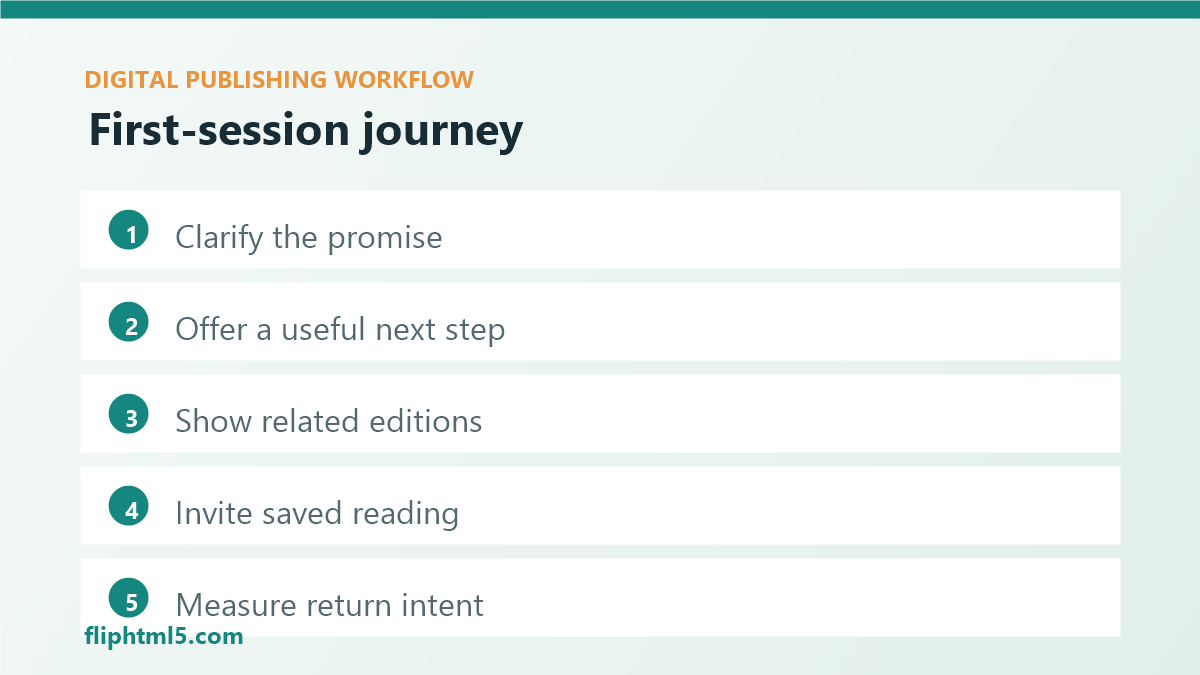
Every onboarding flow should begin with one clear promise: what should a first-time reader be able to accomplish in the first session? For a magazine, the promise might be finding the current issue and saving it for later. For a B2B publisher, it might be discovering a topic hub, downloading a guide, and subscribing to a practical newsletter. For an education publisher, it may be moving from a sample lesson to a full digital workbook.
The promise should be visible in the page structure. A new visitor should quickly see what the publication is, who it helps, what is current, and what they can do next. Use a short contextual welcome module near the article or edition, not a large marketing interruption. The module can point to the latest issue, a topic path, a saved-reading feature, or a newsletter that matches the content they are already reading.
Use content paths instead of generic prompts
Generic calls to action underperform because they ask for commitment before value is clear. A better onboarding flow connects the current page to a content path. A reader who lands on a digital catalog article should see related product guides, interactive flipbooks, and comparison pages. A reader who lands on a publishing strategy article should see a workflow checklist, a topic hub, and a newsletter built around similar problems.
Think of these paths as editorial sequences. They do not need complex personalization at the start. Segment by entry page, topic, format, and intent. Search visitors often need definitions, examples, and next-step resources. Returning newsletter readers may need a saved library or a deeper archive. Social visitors may need a concise explanation of the publication’s value before being asked to subscribe.
Design the first three reader actions
A practical onboarding model is to design the first three actions you want a reader to take. The first action should be low-friction and useful immediately, such as opening the current edition, expanding a table of contents, saving an article, or viewing a related guide. The second action can create continuity, such as following a topic, joining an email list, or creating a free account. The third action can introduce business value, such as starting a trial, requesting a demo, purchasing an issue, or exploring a premium archive.
This sequence keeps the experience human. Instead of asking every new reader to register, the publisher earns the next step through relevance. It also makes measurement clearer. You can track whether visitors move from article to edition, edition to saved item, saved item to newsletter, and newsletter to returning sessions. Those signals are more useful than measuring a single conversion button in isolation.
Make saved reading a core onboarding feature
Digital publications are often consumed across sessions. Readers skim on a phone, return on a laptop, forward a link to a colleague, or save a flipbook for a meeting. A visible save-for-later option can be one of the most useful onboarding tools because it creates a reason to return without demanding a major commitment.
Publishers can support saved reading in several ways: browser-friendly bookmarks, account-based libraries, emailed reading links, downloadable checklists, or persistent recently viewed editions. The right method depends on the publication and audience. The important point is to treat continuity as part of the reading experience, not only as a subscription tactic.
Personalize carefully and explain the value
Onboarding is a natural place for lightweight personalization, but it should be transparent. Ask for topic preferences because they improve future recommendations. Offer format choices because some readers prefer flipbooks, email digests, PDFs, or web articles. Use first-party behavior to improve relevance, but avoid making readers feel tracked or boxed in.
A good preference center can be simple: topics, frequency, preferred formats, and optional role or industry. Keep controls easy to update. If a reader follows a topic, show them where that choice affects recommendations. If they subscribe to a newsletter, explain what they will receive and how often. Trust improves when personalization has visible benefits and visible controls.
Connect onboarding to publishing operations
Reader onboarding is not only a UX project. It depends on metadata, content modeling, editorial planning, and analytics. Topic tags must be consistent enough to power recommendation modules. Excerpts must explain value clearly. Landing pages must connect articles, editions, guides, and newsletter offers. Analytics must show movement across the journey rather than isolated page metrics.
Build onboarding checks into the publish workflow. Before a new article, issue, or flipbook goes live, confirm that it has a next recommended resource, a topic path, a clear excerpt, useful image alt text, and at least one continuity option. This turns onboarding from a one-time redesign into a repeatable publishing habit.
Measure habit, not just conversion
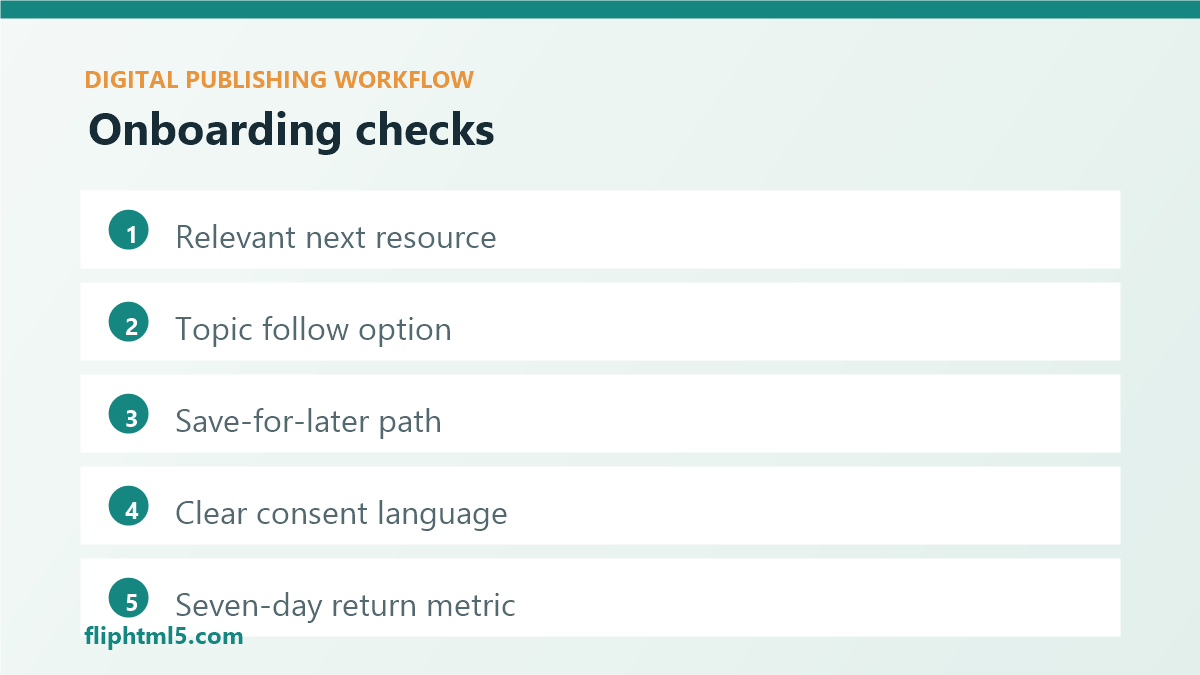
The best onboarding metrics look beyond immediate sign-ups. Track first-session depth, return rate within seven days, saved items, topic follows, newsletter confirmation rate, edition completion, and movement from anonymous visits to known readers. For commercial publishers, connect those signals to trials, renewals, product inquiries, or paid issue purchases.
Review the journey monthly. Which entry pages create the most returning readers? Which content paths lead to subscriptions? Which prompts are ignored? Which editions are saved but not completed? These answers help publishers improve article structure, internal linking, content packaging, and newsletter positioning.
Bottom line
Digital publishing teams compete for attention in crowded feeds, search results, inboxes, and AI-mediated discovery surfaces. Reader onboarding gives that attention somewhere useful to go. By mapping the first-session promise, creating content paths, designing the first three reader actions, supporting saved reading, and measuring habit formation, publishers can turn more first visits into durable audience relationships.