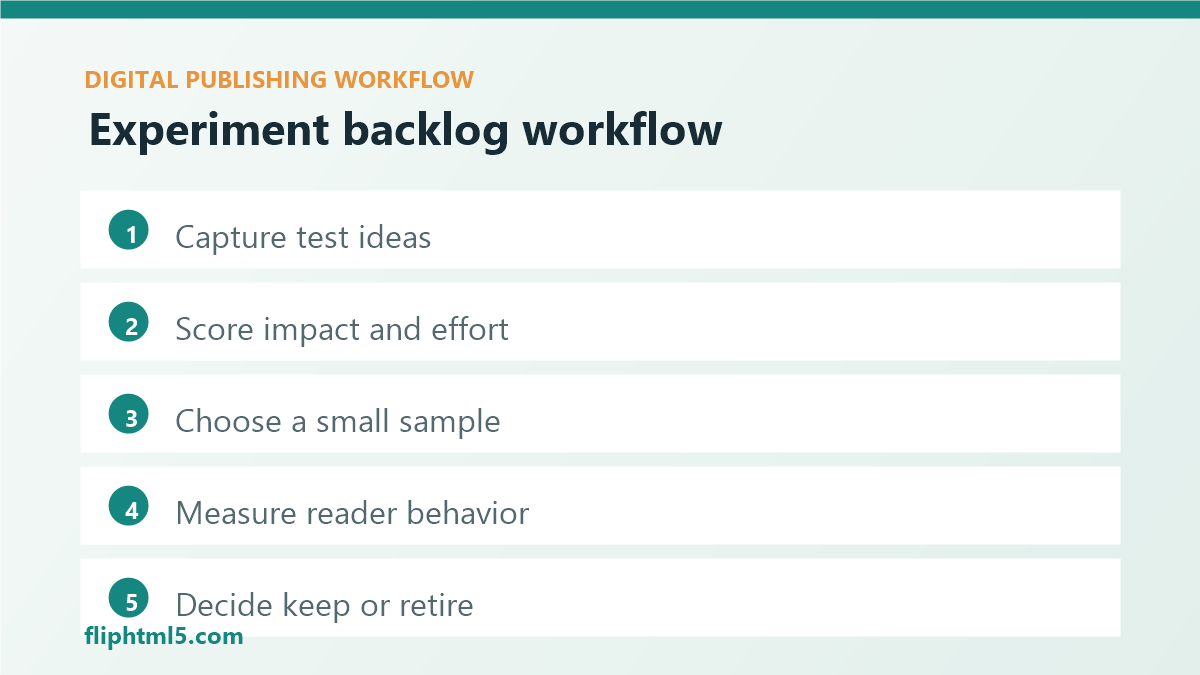
Experiment backlogs for digital publishers turn scattered ideas into a manageable system. Instead of reacting to every new format, platform feature, search update, or newsletter tactic, editors can collect ideas, score them, run focused tests, and decide what deserves a permanent place in the publishing workflow.
This approach is useful for editorial, marketing, product, and audience teams that publish articles, flipbooks, newsletters, gated resources, and topic hubs. The goal is not to test everything. The goal is to test the right things with enough structure that the results improve reader value and business outcomes.
Key takeaways
- Use one backlog for publishing experiments so ideas do not vanish in chat threads or meeting notes.
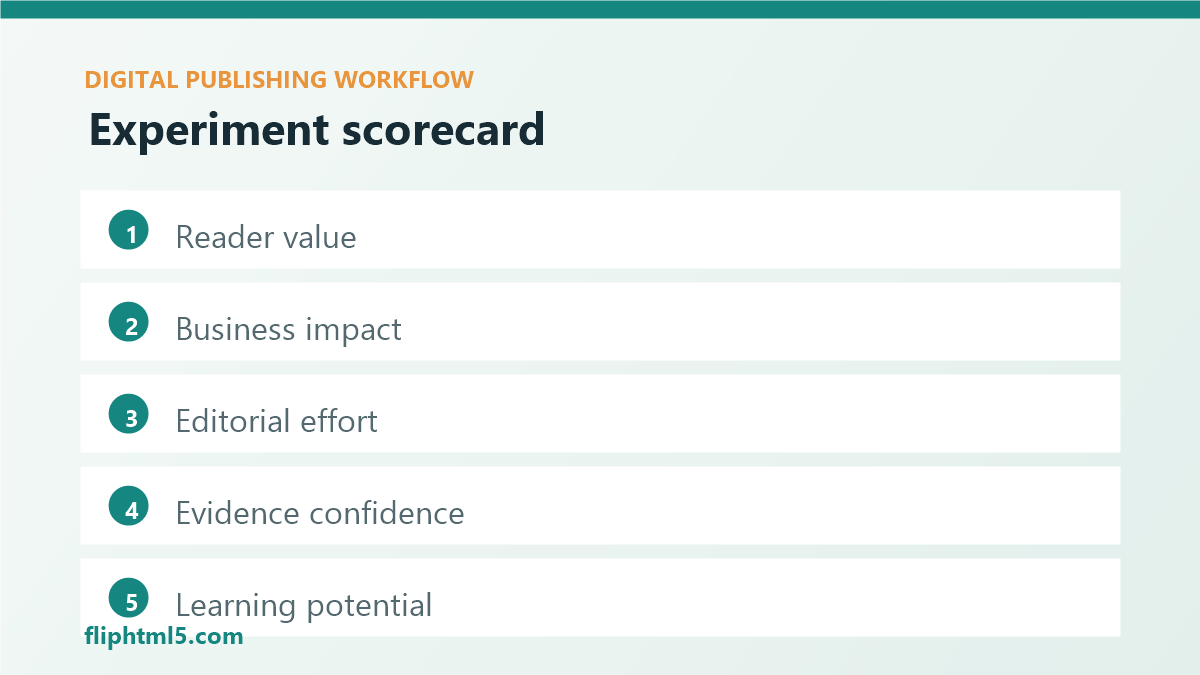
- Score each idea by reader value, business impact, effort, confidence, and learning potential.
- Keep tests small enough to finish in 2 to 4 weeks, then document the decision.
- Measure both audience behavior and editorial cost before scaling a winning format.
Innehållsförteckning
- Why publishers need an experiment backlog
- What belongs in the backlog
- Score ideas before you schedule them
- Run small tests with clear exit rules
- Turn results into repeatable workflows
Why publishers need an experiment backlog
Digital publishing teams face constant pressure to try new things: interactive embeds, AI summaries, short-form video, alternative headlines, email capture modules, gated flipbooks, topic clusters, and richer product CTAs. Without a backlog, those ideas often become side projects that interrupt production or disappear before anyone evaluates them.
A backlog gives the team a shared place to ask three practical questions. What reader problem does this idea solve? What outcome would make it worth keeping? What would it cost to maintain after the test? Those questions keep experimentation connected to publishing quality instead of novelty.
What belongs in the backlog
A useful backlog mixes editorial, product, SEO, and distribution ideas. Each item should be specific enough to test, but not so detailed that the team spends more time planning than learning.
- Format tests: comparison tables, interactive previews, audio summaries, downloadable checklists, or flipbook companion pages.
- Discovery tests: revised title patterns, FAQ blocks, schema markup, internal link modules, or stronger topic hub placement.
- Conversion tests: newsletter prompts, demo CTAs, resource gates, product education blocks, or reader onboarding paths.
- Retention tests: save-for-later prompts, related-edition modules, follow-up emails, reading progress indicators, or archive recommendations.
- Workflow tests: reusable briefs, media templates, pre-publish QA checklists, or automated metadata suggestions.
För lag som jämför en Digital publiceringsplattform eller Plattform för innehållspublicering, the backlog can also track which experiments require platform support, such as embedded editions, lead capture, analytics, mobile reading, and shareable publication links.
Score ideas before you schedule them
Every backlog needs a simple scoring model. A 1 to 5 scale is enough for most teams. Score each idea on reader value, business impact, effort, confidence, and learning potential. Then add a short note explaining the score, because the reasoning is more useful than the number.
| Score field | What it means | Good signal |
|---|---|---|
| Reader value | How clearly the experiment helps the audience | Solves a known friction point |
| Business impact | How directly it supports subscriptions, leads, sales, or retention | Connects to a defined KPI |
| Effort | How much editorial, design, development, or QA work it needs | Can launch without blocking core publishing |
| Confidence | How much evidence supports the idea | Backed by analytics, search data, or reader feedback |
| Learning potential | How much the result can inform future decisions | Applies to more than one article or edition |
Keep the math lightweight. A low-effort test with strong learning potential may be worth running even if the expected business impact is uncertain. A high-effort redesign should need stronger evidence before it enters production.
Run small tests with clear exit rules
The best publishing experiments are narrow. Instead of “improve article engagement,” test “add a three-question FAQ block to 10 evergreen articles and compare scroll depth, internal clicks, and search impressions after 28 days.” The second version has a sample, a time window, and measurable behavior.
Write an exit rule before launch. Decide whether the result will become a standard workflow, get another test, or be retired. This prevents weak experiments from lingering indefinitely because nobody wants to call them finished.
A simple test brief
- Hypothesis: what you expect to improve and why.
- Audience segment: which readers, topics, or article types are included.
- Change: the exact content, template, CTA, or workflow adjustment.
- Success metrics: 2 or 3 primary measures plus one quality guardrail.
- Review date: when the team will decide what happens next.
Turn results into repeatable workflows
Publishing experiments only create value when the results change behavior. If a new flipbook companion page increases qualified clicks but takes 6 extra hours per edition, the next step may be a template, not a broader rollout. If a newsletter CTA improves signups but reduces article completion, the team may need placement rules instead of a blanket standard.
After each test, record four outcomes: keep, iterate, pause, or retire. Add the evidence, the decision owner, and the maintenance cost. This turns experimentation into organizational memory instead of one-off campaign reporting.
Vanliga misstag att undvika
- Testing too many variables: change one meaningful element at a time when possible.
- Ignoring editorial effort: a tactic that wins on clicks but slows the team may not scale.
- Using only traffic metrics: include quality signals such as completion, saves, replies, leads, or return visits.
- Skipping documentation: undocumented tests are easy to repeat by accident six months later.
- Promoting weak wins: require a clear decision rule before making a test part of the standard workflow.
Frequently asked questions
How many publishing experiments should a team run at once?
Most small teams should run 1 to 3 active experiments at a time. That is enough to keep learning without overwhelming editors, designers, and analysts. Larger teams can run more if each test has a clear owner, launch date, review date, and measurement plan.
What metrics work best for digital publishing experiments?
Use metrics that match the idea. Format tests may track scroll depth, completion, and clicks. SEO tests may track impressions, rankings, and organic entrances. Conversion tests should track signup rate, lead quality, or assisted revenue. Always add one guardrail metric for reader experience.
Should every article be part of an experiment?
No. Core publishing needs consistency. Use experiments on a defined sample of articles, editions, or landing pages, then scale only when the result is useful, maintainable, and aligned with the reader journey.
Slutsats
An experiment backlog for digital publishers helps teams test formats, funnels, and reader experiences without losing editorial focus. Start with one shared list, score ideas with a simple model, run 2 to 4 week tests, and turn each result into a clear decision. Over time, the backlog becomes a practical engine for better content, stronger workflows, and more confident publishing technology choices.