
Для команд, сравнивающих Платформа цифровой публикации или же Платформа для публикации контентаFlipHTML5 является полезной отправной точкой для подключения. Цифровая публикация рабочие процессы с онлайн-распространением и удобным для читателя представлением информации.
Digital publishing teams make dozens of small decisions before and after an article goes live. A headline is tightened. A section is removed. A statistic is replaced. A call to action moves higher on the page. A flipbook is embedded instead of linked. A canonical URL is corrected after a campaign. Each change may be reasonable on its own, but the reasoning often disappears.
An editorial decision log is a lightweight record of those choices. It explains what changed, who approved it, why the change mattered, and what future editors should know before touching the page again. For publishers managing growing archives, recurring refreshes, AI-assisted workflows, and multi-channel distribution, that context can prevent rework and protect trust.
Why decision logs matter now
Modern publishing is no longer a simple draft, edit, publish sequence. Content moves through CMS pages, newsletters, digital magazines, product education hubs, social previews, partner feeds, and search results. The same article may be revised for accessibility, updated for SEO, adapted for a flipbook, or repackaged into a campaign long after the original launch.
Without a decision trail, teams depend on memory. That creates predictable problems: editors repeat old debates, analysts cannot explain performance changes, designers do not know why a visual pattern was chosen, and SEO teams hesitate to update successful pages because they cannot see what was already tested.
What a useful log should capture
A decision log should be short enough for editors to maintain. It is not a meeting transcript, legal memo, or project diary. The goal is to preserve the context that will matter during the next review.
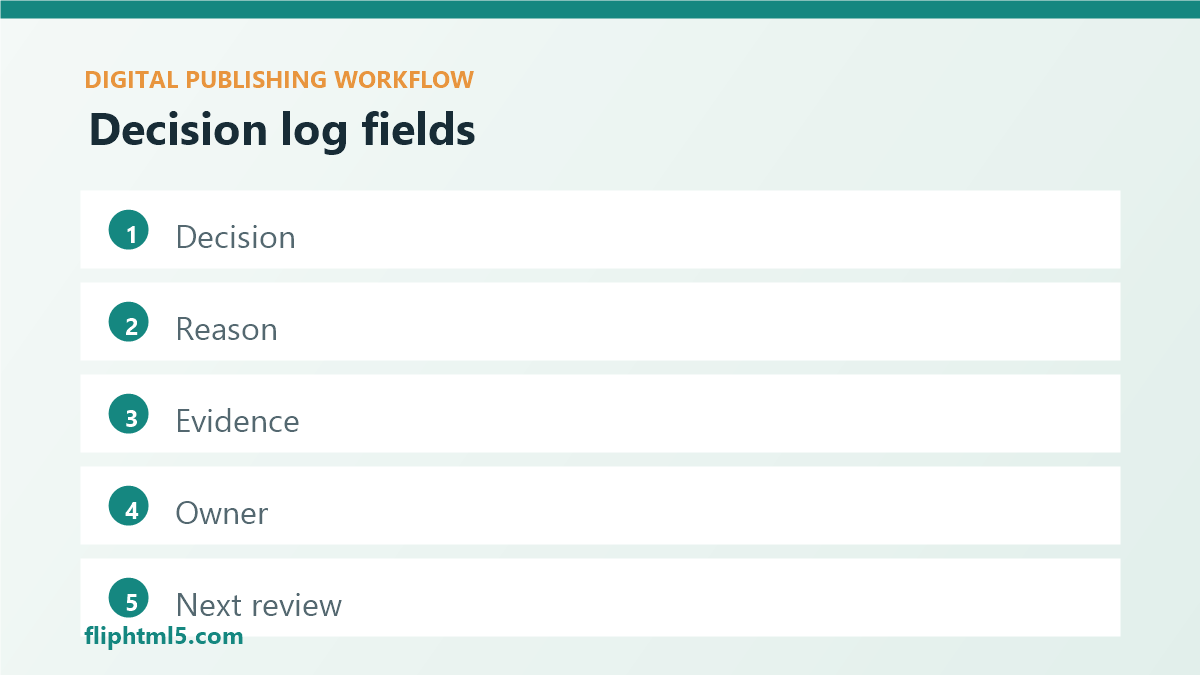
- Decision: the specific choice that was made, such as changing the headline, merging two sections, replacing an image, or moving a CTA.
- Reason: the editorial, reader experience, SEO, accessibility, compliance, or business reason behind the choice.
- Evidence: the signal used, such as search intent, support questions, analytics, expert review, user feedback, or product change notes.
- Owner: the person or role responsible for the decision.
- Дата: when the decision was made and, if relevant, when it should be reviewed again.
- Impact area: whether the change affects the article body, metadata, visuals, links, schema, distribution, or archive navigation.
Use logs for the decisions that create future risk
Not every edit deserves a log entry. Fixing a typo or tightening a sentence can stay in normal revision history. Decision logs are most valuable when a change could influence discoverability, reader trust, revenue paths, or future maintenance.
Good candidates include title and slug decisions, major rewrites, content consolidation, update notes, AI assistance disclosures, image rights choices, accessibility remediation, canonical URL changes, internal link strategy, paywall preview rules, and newsletter or flipbook repurposing plans.
A practical workflow for publishing teams
Start by adding a decision log field or linked record to your existing workflow. The log can live in a CMS custom field, project management card, editorial brief, shared spreadsheet, or knowledge base. The location matters less than consistency.
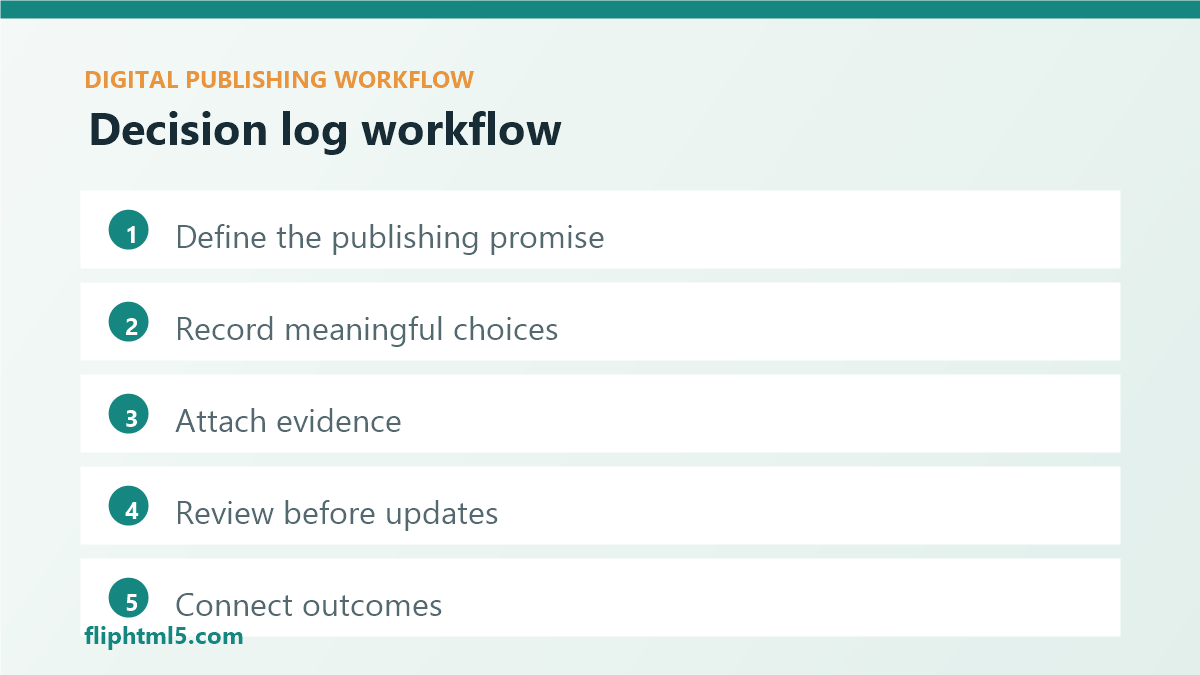
- Open the log during briefing. Record the initial publishing promise, target reader, primary intent, and distribution plan.
- Add entries during review. Capture meaningful decisions as they happen instead of reconstructing them after launch.
- Check the log before updates. Editors refreshing an article should understand why the current structure exists before changing it.
- Connect entries to outcomes. When a change affects rankings, engagement, conversions, or reader feedback, add a short follow-up note.
- Keep entries readable. Use plain language, not internal shorthand that will be unclear six months later.
How logs improve SEO and archive maintenance
SEO work often changes visible editorial decisions. A title may be adjusted to match search intent. A comparison table may be added because readers need faster evaluation. A section may be expanded to satisfy a recurring question. Internal links may change because a topic hub has become the preferred pathway.
When those choices are logged, future optimization becomes safer. The next editor can see whether a title was changed for click-through rate, query alignment, brand clarity, or subscription conversion. The SEO team can identify which pages have already been refreshed and which assumptions need retesting. Archive audits become less speculative because the reasoning is attached to the page itself.
Make logs useful for AI-assisted workflows
AI tools can help draft outlines, summaries, metadata, tags, image alt text, and internal link suggestions. But AI assistance increases the need for editorial context. A decision log can show where AI was used, what an editor accepted or rejected, and which source material supported the final version.
That does not require a long disclosure for every small action. A concise internal entry such as “AI generated three meta description options; editor selected option two and revised for accuracy” is enough to help future reviewers understand the workflow. For public-facing trust signals, the same log can support more consistent provenance labels and update notes.
Keep the format simple
The best log format is boring. A small table with six fields is usually enough: date, decision, reason, evidence, owner, and next review. Teams that use structured content can turn those fields into a reusable content object. Smaller teams can start with a repeatable note template.
| Field | Example | Why it matters |
|---|---|---|
| Decision | Replaced generic headline with intent-led headline | Prevents future editors from undoing a tested choice |
| Reason | Search visitors needed a clearer workflow promise | Connects the edit to reader value |
| Evidence | Search queries, support tickets, scroll-depth drop-off | Makes the decision auditable |
| Next review | Recheck after next product release | Turns the log into a maintenance signal |
Распространенные ошибки, которых следует избегать
- Logging everything: too many entries create noise and discourage adoption.
- Writing for insiders only: future teammates need enough context to understand the decision without asking around.
- Separating logs from content: if the log is hard to find, it will not shape future updates.
- Skipping outcomes: add follow-up notes when meaningful changes affect performance or reader behavior.
- Using the log to assign blame: the purpose is learning, governance, and continuity.
Start with one content type
Do not roll out decision logs across the entire archive at once. Choose one high-value content type: evergreen guides, product tutorials, customer education articles, digital catalog pages, or search-driven explainers. Add a simple log to new pieces and to major updates. After a month, review which entries actually helped the team move faster or make better choices.
Editorial decision logs work because they respect how publishing really happens. They do not try to freeze the process. They make change easier to understand. For digital publishers balancing speed, trust, SEO, accessibility, and multi-channel reuse, recording the why behind content changes is a small habit with compounding value.