
Pentru echipele care compară o Platformă de publicare digitală sau Platformă de publicare a conținutului, FlipHTML5 este un punct de referință util pentru conectarea Editura digitală fluxuri de lucru cu distribuție online și prezentare ușor de citit.
Digital publishing teams are no longer shipping one article to one page. A feature story may need to appear as a CMS article, an interactive flipbook, a newsletter module, an app card, a partner feed, a sales enablement asset, and a short social preview. When every channel requires manual copying, the workflow becomes slow, brittle, and hard to measure.
Composable content APIs solve that problem by treating content as structured data that can be assembled, rendered, and reused across many publishing surfaces. The API does not replace editorial judgment. It gives editors, marketers, and product teams a cleaner way to move approved content where it needs to go without rebuilding the same asset from scratch.
What a composable publishing workflow looks like
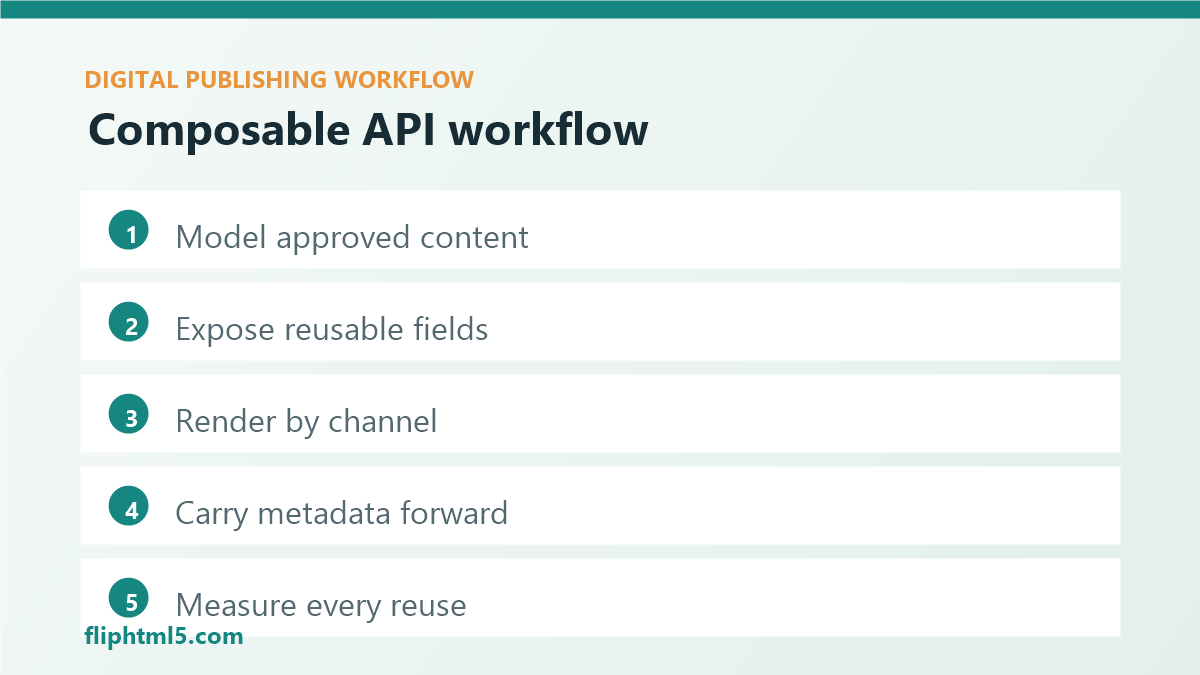
In a traditional workflow, a page template often becomes the source of truth. In a composable workflow, the source of truth is the approved content object: title, dek, body sections, media, author data, topic relationships, calls to action, licensing rules, and tracking metadata.
Different channels then request the pieces they need. A web article may render the full story. A flipbook may use the hero, summary, pull quotes, and visual sections. A newsletter may pull the headline, thumbnail, excerpt, and link. An app may display a compact card with reading time and save-for-later status.
Why APIs matter for digital publishers
- Reuse becomes reliable: teams can republish approved blocks without copying text into disconnected tools.
- Brand consistency improves: headlines, descriptions, author names, and images stay aligned across channels.
- SEO metadata is easier to govern: canonical URLs, topic labels, excerpts, and internal links can travel with the content.
- Measurement gets cleaner: content IDs and campaign fields can follow each asset through web, email, apps, and partner distribution.
- Accessibility rules scale: required alt text, captions, language fields, and reading order can be checked before assets move downstream.
The core building blocks
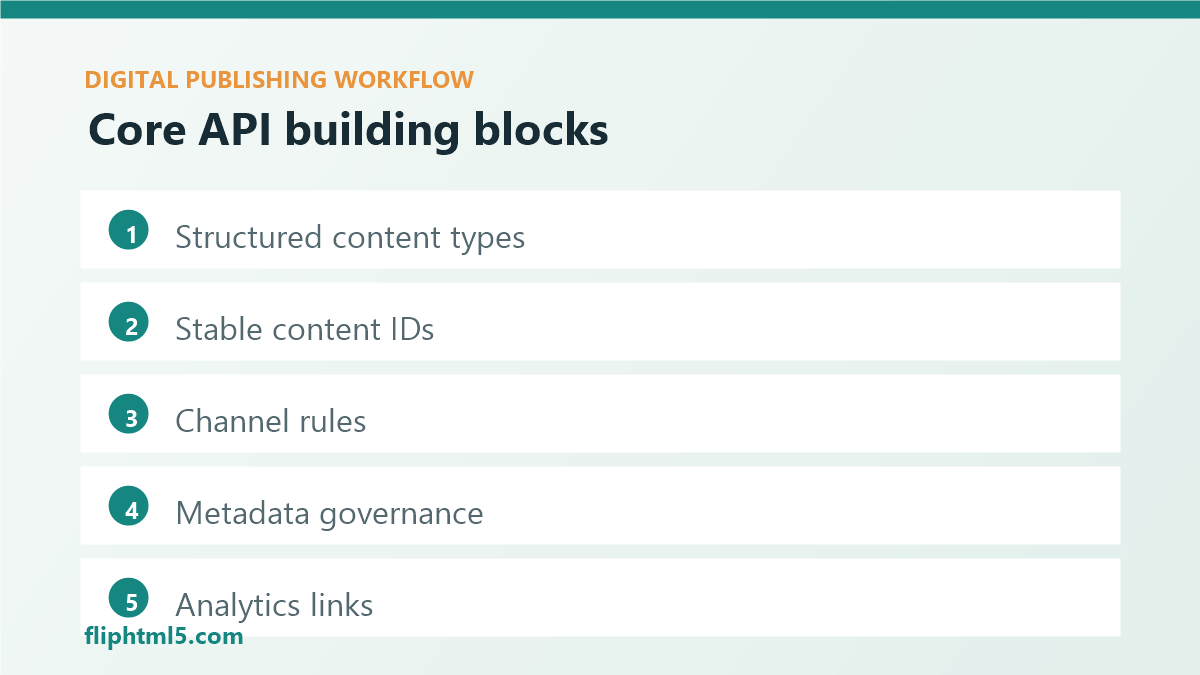
1. Structured content types
Start by defining the repeatable content types your publication actually uses: articles, guides, product updates, interviews, reports, catalogs, flipbooks, and newsletter editions. Each type should have required fields, optional fields, and editorial guidance.
2. Stable content IDs
Every reusable asset needs a persistent ID. This lets analytics, internal links, syndication feeds, and update workflows understand that the same story may appear in multiple places.
3. Channel-specific renderers
A composable API should not force every surface to look the same. Instead, each channel can render the same approved content in the format that works best: a long-form page, a flipbook spread, a newsletter teaser, a mobile card, or a downloadable handout.
4. Governance fields
Add fields that protect the business side of publishing: rights status, expiration date, sponsor disclosure, canonical URL, noindex rules, update notes, and allowed distribution channels. These fields prevent small mistakes from becoming public problems.
Un plan practic de implementare
You do not need to rebuild the entire stack at once. A small pilot is usually enough to prove value.
- Choose one high-reuse format: start with guides, catalogs, reports, or newsletter features that often become multiple assets.
- Define the minimum schema: title, summary, body sections, hero image, alt text, author, topics, canonical URL, CTA, and source ID.
- Connect two outputs: for example, CMS article plus newsletter module, or report page plus flipbook asset.
- Add QA gates: validate missing metadata, broken links, image dimensions, and accessibility fields before publishing.
- Measure reuse: track time saved, update accuracy, channel performance, and content blocks most frequently reused.
Greșeli frecvente de evitat
- Modeling everything too early: start with the fields needed for real publishing outputs.
- Letting channels fork the copy: allow channel-specific summaries, but keep the approved core content connected to the source record.
- Ignoring editorial usability: structured content only works if editors can preview, validate, and adjust content without fighting the CMS.
- Forgetting ownership: assign clear owners for schema changes, taxonomy cleanup, and API documentation.
How this supports SEO and audience growth
Composable content is not just a technical architecture. It improves discoverability because metadata becomes more consistent, internal links can be generated from topic relationships, and updates can flow to related surfaces without delay. It also supports audience development by making it easier to turn one strong piece into a newsletter journey, gated download, app notification, or evergreen hub.
Concluzie
Digital publishers need workflows that let content travel without losing quality. Composable content APIs create that foundation: one approved source, structured fields, reusable blocks, governed metadata, and channel-specific presentation. Start with one content type and two outputs, then expand as the workflow proves itself.