
Digital publishing lets a single article, flipbook, catalog, report, or campaign reach readers in many markets within hours. The challenge is making that reach feel local. A direct translation can preserve the words while losing the reader’s context: the wrong example, outdated screenshot, unfamiliar currency, weak metadata, or call to action that does not match the region.
Localization workflows give publishing teams a repeatable way to adapt content for global readers without treating every language version as a brand-new project. The workflow connects editorial planning, translation context, visual review, metadata, accessibility, and launch QA so localized editions feel useful, trustworthy, and discoverable.
Key takeaways
- Localization should start during briefing, not after the source article is finished.
- Digital publishers need to adapt examples, visuals, links, metadata, CTAs, and compliance notes, not only body copy.
- A shared localization kit reduces rework for translators, editors, designers, and SEO teams.
- Localized versions need their own quality checks for readability, accessibility, search intent, and conversion paths.
- Performance data from each market should feed future briefs and content updates.
Why localization needs a publishing workflow
Many localization problems happen because translation is treated as the last production step. By then, the article structure is fixed, screenshots have already been exported, internal links point to one market, and the SEO title was written for one search behavior. Regional editors can still rescue the page, but they are forced to work around choices that were never designed for adaptation.
A better workflow begins with the source brief. The editor identifies which sections are universal and which sections need local judgment. Product names, legal claims, seasonal references, lead magnets, pricing, units of measure, and customer examples are flagged before translation begins. That gives local reviewers a map instead of a mystery.
Build a localization kit before translation
A localization kit is a compact package of context that travels with the source content. It should be short enough for busy collaborators to use, but specific enough to prevent guesswork.
- Audience goal: who the localized version should help and what action matters most.
- Search intent: target queries, related phrases, and whether the market uses different vocabulary.
- Terms to preserve: product names, brand phrases, technical terms, and approved translations.
- Adaptation zones: examples, links, screenshots, offers, statistics, and compliance notes that may need local replacement.
- Visual assets: source files, alt text, captions, and notes on text embedded inside images.
- Review owner: the person responsible for final regional accuracy before publication.
For teams using a Digital Publishing Platform or Content Publishing Platform, this kit is especially useful because one source package may become a web article, online flipbook, email feature, downloadable guide, and campaign landing page.
Localization workflow map
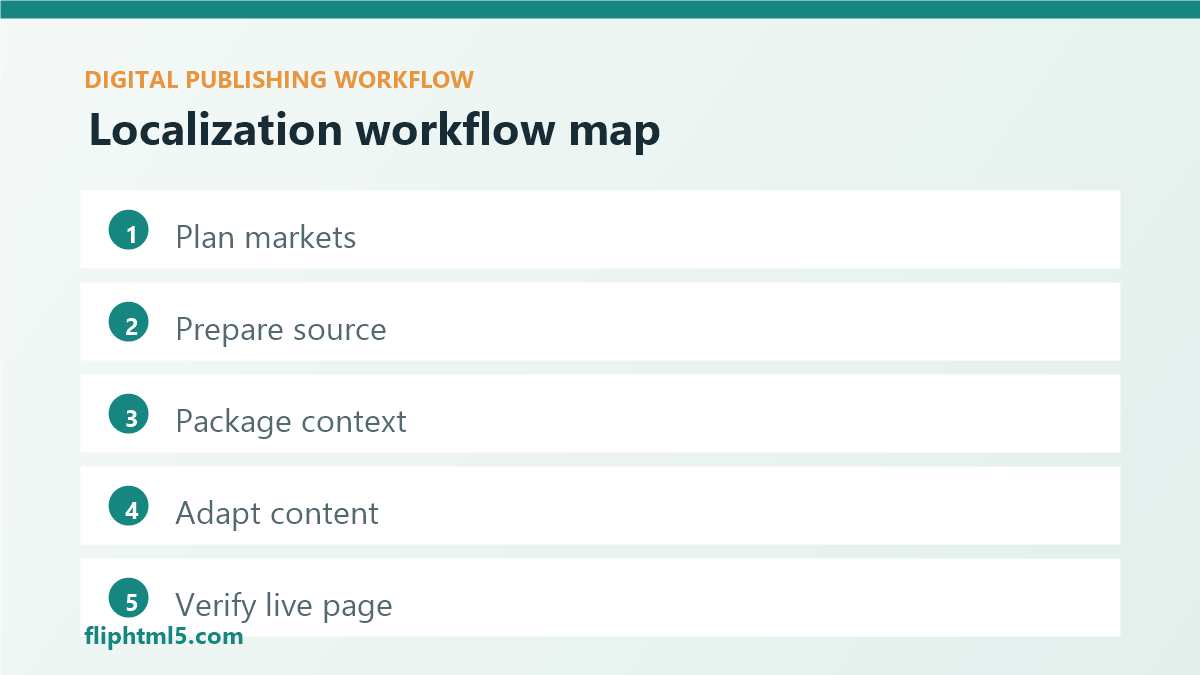
A practical localization workflow does not need to be complicated. It needs clear handoffs. The source editor prepares adaptable content, the translator receives enough context, the regional reviewer checks local fit, the production team updates media and metadata, and the publisher verifies the live reader experience.
- Plan for markets: decide which languages and regions need full adaptation, light translation, or a market-specific page.
- Prepare the source: separate reusable guidance from local examples, and avoid idioms that will not travel well.
- Package context: include glossary notes, source links, asset files, SEO intent, and CTA requirements.
- Translate and adapt: localize the meaning, not just the sentence order.
- Review the experience: check mobile layout, images, captions, forms, links, downloads, and analytics tags.
- Publish and measure: compare engagement, search visibility, saves, downloads, and conversion paths by market.
Adapt metadata for regional discovery
Localized content often underperforms when teams translate the headline but ignore how readers search. A literal phrase may be correct and still miss the words people use in that market. Digital publishers should localize the SEO title, meta description, URL slug, headings, internal links, image alt text, and structured data where relevant.
Search behavior can also reveal different reader priorities. One market may search for “digital catalog maker,” another for “online brochure,” and another for “interactive PDF.” The localized page should answer the local query while staying aligned with the source article’s promise.
Review visuals, examples, and calls to action
Images are a common weak point in localized publishing. Screenshots may show the wrong language, currency, interface, date format, or legal notice. Charts may use labels that were never translated. A beautiful hero image can feel generic if it does not match the reader’s context.
CTAs also need review. A newsletter signup, demo request, downloadable template, flipbook sample, or product link should lead to the right regional destination. If the localized article sends readers back into an untranslated funnel, the experience feels unfinished.
Localization QA checklist
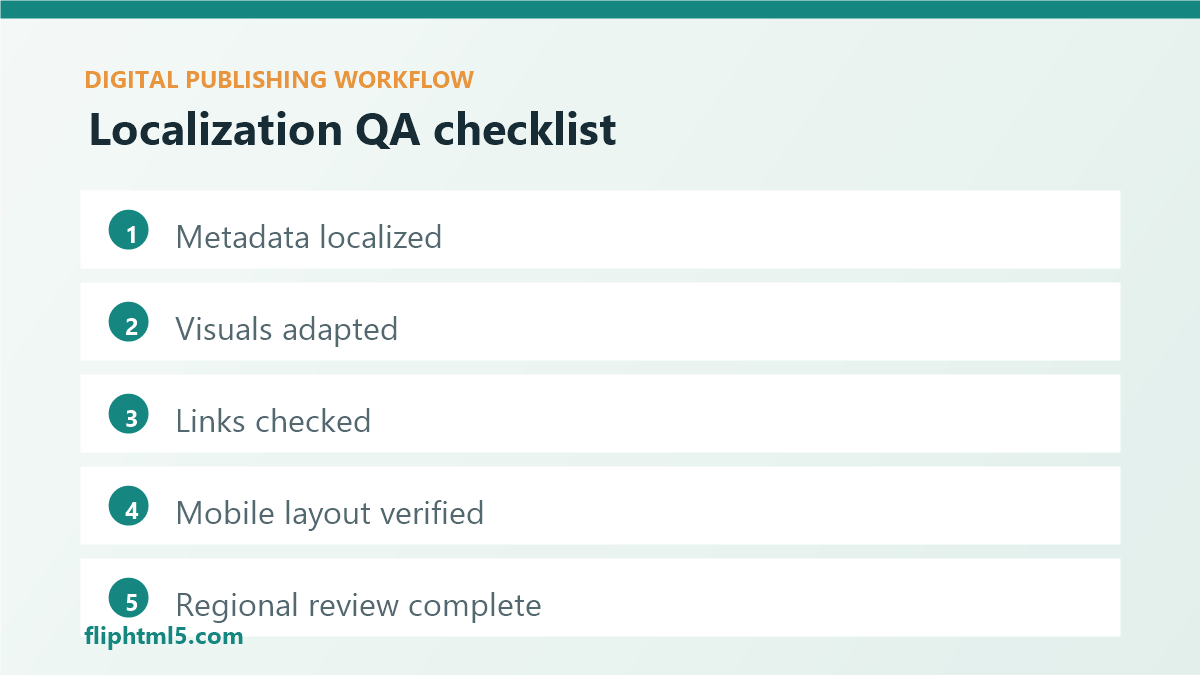
Before publishing a localized article or edition, run a focused QA pass. The goal is not perfection for its own sake. The goal is to protect trust and remove avoidable friction.
Pre-publish checks
- Does the title match local search behavior and reader vocabulary?
- Are examples, statistics, prices, screenshots, and dates locally appropriate?
- Do internal links point to useful pages in the same language or region?
- Are image alt text, captions, and downloadable assets localized?
- Does the page work on mobile after text expansion?
- Are forms, CTAs, consent notices, and analytics tags region-ready?
- Has a regional reviewer approved accuracy and tone?
Use performance data to improve the next brief
Localization should become smarter with each release. Track which markets read deeply, which CTAs earn clicks, which translated titles gain impressions, and where readers exit. Those signals should feed the next source brief, glossary, and localization kit.
For example, if a market responds strongly to comparison tables, the next article can include a table designed for easy translation. If another market ignores a generic download CTA, the regional editor can test a more specific resource. Localization improves when publishing teams treat each market as a source of editorial learning, not only a distribution endpoint.
Conclusion
Localization is a publishing discipline, not a final text conversion. When teams plan for adaptation early, package context clearly, localize metadata, review visuals, and measure each market’s response, global content becomes more useful and more trustworthy. For digital publishers managing articles, flipbooks, newsletters, and campaigns, a repeatable localization workflow turns international reach into reader-ready experiences.