

AI-assisted editorial style guides help digital publishers keep language, structure, metadata, and reader experience consistent across articles, flipbooks, newsletters, catalogs, landing pages, and social campaigns. The goal is not to let automation flatten the brand voice. The goal is to give editors a practical control layer so every draft, prompt, rewrite, summary, and repurposed asset starts from the same standards.
As publishing teams produce more formats from the same source material, small inconsistencies become expensive. A product name changes across channels. A newsletter summary promises something the article does not cover. A flipbook caption uses different terminology from the landing page. Alt text is skipped. SEO fields are written from scratch every time. A living style guide turns those repeated decisions into reusable rules.
핵심 요약
- An AI-assisted style guide should define voice, terminology, structure, metadata, accessibility, and channel rules.
- The guide works best when it is short enough for editors to maintain and specific enough for AI tools to apply.
- Publishers should separate fixed rules from judgment calls so automation supports editors instead of replacing review.
- Style-guide checks should happen before publication and again when content is repurposed for newsletters, flipbooks, or campaigns.
- Every rule needs an owner, an example, and a review cadence so the guide does not become stale documentation.
목차
- Why style guides matter more in AI-assisted publishing
- The six components of a useful guide
- How to use the guide in daily workflow
- Where human editors still matter
- Channel rules for articles, flipbooks, and newsletters
- A practical style-guide template
비교하는 팀의 경우 디지털 출판 플랫폼 또는 콘텐츠 게시 플랫폼, the style guide should travel with the content. The same standards should shape the article page, digital edition, embedded flipbook, excerpt, image text, and campaign copy.
Why style guides matter more in AI-assisted publishing
Traditional style guides were often written for editors and writers. AI-assisted publishing adds new users: prompt builders, content operations teams, marketers, localization reviewers, SEO editors, and tools that generate summaries or rewrite copy for different surfaces. If the guide is vague, every channel invents its own version of the brand.
A strong guide gives AI tools boundaries. It can specify preferred terms, banned phrases, headline patterns, reading level, citation expectations, accessibility rules, call-to-action language, and metadata requirements. That does not remove editorial judgment. It gives editors a cleaner first draft and a clearer checklist for what must be corrected before publication.
The most useful guides are operational rather than decorative. They include examples of acceptable and unacceptable output. They explain how rules change by format. They also identify which issues block publication, which issues are preferences, and which issues need escalation to a subject-matter expert.
The six components of a useful guide
Digital publishers do not need a 100-page manual to benefit from AI-assisted standards. Start with six practical components and expand only when the team repeatedly encounters a problem.
Editorial style guide framework
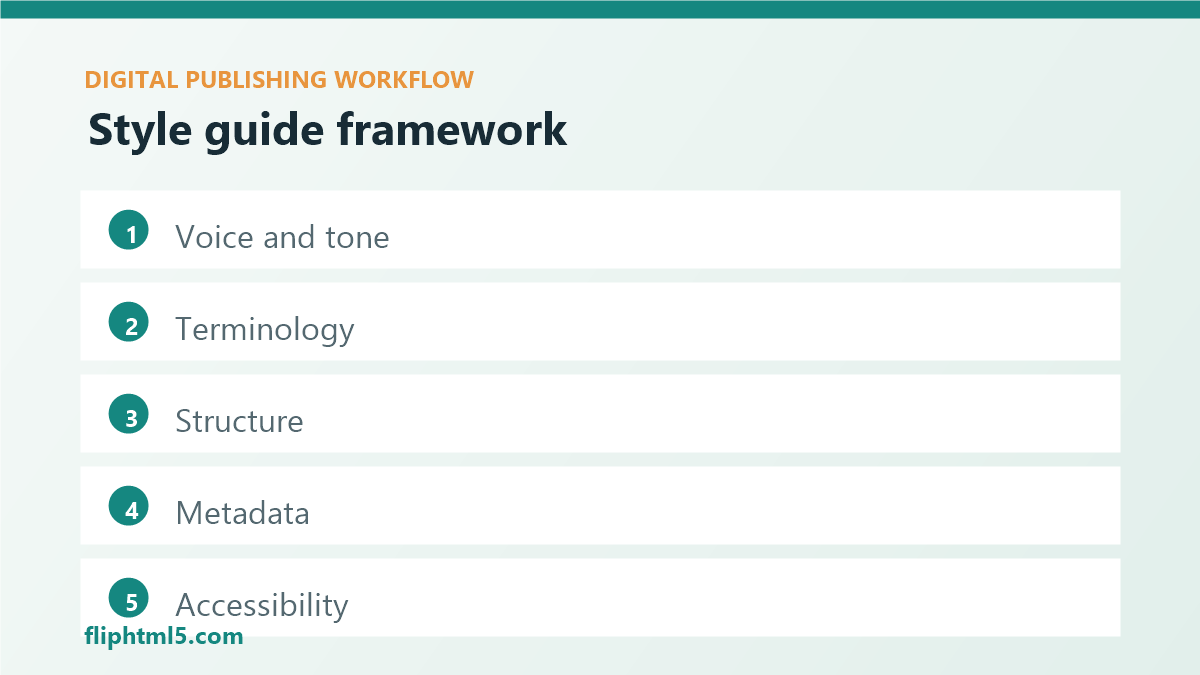
- Voice and tone: define how the publication should sound, including formality, sentence length, point of view, and how directly the brand speaks to readers.
- Terminology: list preferred names, product terms, category labels, industry phrases, acronyms, and words the team should avoid.
- 구조: document article patterns, heading hierarchy, introductions, key takeaways, FAQs, conclusions, and internal-link placement.
- 메타데이터: set rules for title tags, meta descriptions, excerpts, slugs, alt text, captions, tags, and category choices.
- 접근성: require descriptive links, useful image alternatives, readable headings, captions or transcripts, and clear summaries for embedded media.
- Channel adaptation: explain how the same source content changes for web articles, flipbooks, newsletters, social previews, and downloadable formats.
Each component should include at least one example. A rule such as “write clear headlines” is too broad for people or AI. A better rule says that web headlines should name the reader problem, include the main topic, avoid unexplained acronyms, and stay within a practical length for search and social previews.
How to use the guide in daily workflow
The style guide should appear in the workflow before content is drafted, while content is edited, and when finished content is repurposed. If it only appears at final approval, editors spend too much time fixing avoidable drift.
AI-assisted style guide workflow
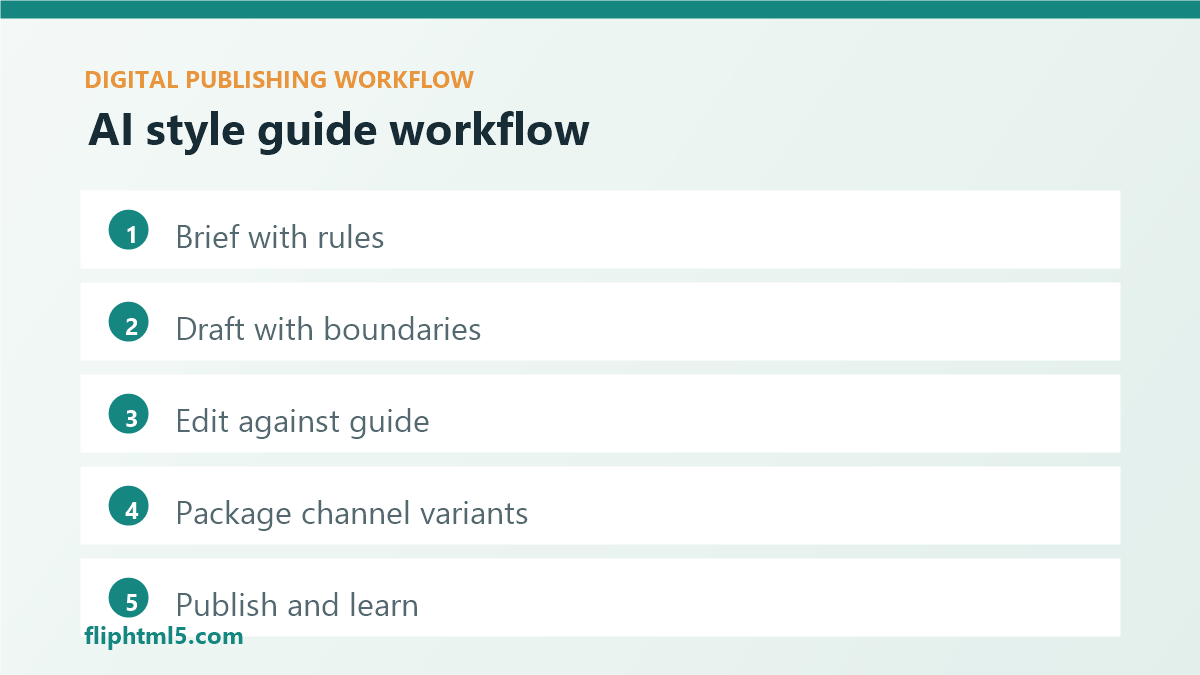
- Brief: attach the relevant voice, terminology, metadata, and channel rules to the content brief before drafting begins.
- Draft: ask AI tools to follow the selected rules and identify any places where the rules are ambiguous.
- Edit: review the draft against the style guide, not just for grammar or readability.
- Package: apply the same standards to excerpts, captions, image alternatives, newsletters, flipbook notes, and social copy.
- Publish: run a final checklist for headline, metadata, internal links, accessibility, category, tags, and call to action.
- Learn: record recurring issues so the guide improves after each publishing cycle.
This process is especially useful for teams that repurpose one article into many assets. A long guide might not be read every day, but a focused prompt-ready version can be embedded in content briefs, CMS notes, or production checklists.
Where human editors still matter
AI can apply rules, but it cannot own editorial responsibility. Human editors still need to decide whether claims are accurate, whether examples match the audience, whether sources are sufficient, whether the tone fits the moment, and whether the content should be published at all.
The guide should make this division visible. Some checks can be automated: title length, missing meta description, empty alt text, banned terms, heading skips, or category omissions. Other checks require judgment: whether a technical explanation is oversimplified, whether a comparison is fair, whether a claim needs evidence, or whether a call to action feels premature.
A practical review model uses three labels. Required rules block publication when missed. Editorial preferences guide rewrites but may allow exceptions. Escalation rules identify topics that require legal, product, accessibility, or subject-matter review.
Channel rules for articles, flipbooks, and newsletters
Digital publishing consistency does not mean every channel uses the same words. It means every channel supports the same promise. The article can be detailed, the flipbook can be visual, the newsletter can be concise, and the social preview can be direct, but all four should use the same terminology, reader benefit, and destination URL.
Channel consistency checklist
- Web article: confirm the title, H1, intro, headings, internal links, metadata, schema fields, and visible call to action.
- Flipbook or digital edition: check cover text, table of contents, captions, link labels, navigation prompts, and landing-page summary.
- Newsletter: align subject line, preview text, excerpt, button text, and tracking parameters with the article promise.
- Social preview: use the approved title or short variant, image-safe text, clear source attribution, and a matching destination page.
- Archive entry: preserve the canonical title, description, category, tags, update date, and related content links.
When teams use AI to generate these variants, the prompt should include the channel goal, required terms, banned claims, target length, and final URL. The editor should compare the variant against the source article before scheduling distribution.
A practical style-guide template
Use this lightweight template as a starting point. It can live in a CMS note, shared document, content brief, or prompt library.
AI-assisted editorial style guide template
청중: [Primary reader, knowledge level, decision stage]
Voice: [Direct, practical, expert, friendly, formal, or other defined tone]
Preferred terms: [Product names, category labels, spelling choices, acronyms]
Terms to avoid: [Vague phrases, risky claims, off-brand language, unsupported superlatives]
Article structure: [Intro pattern, heading style, key takeaways, FAQ use, conclusion pattern]
Metadata rules: [Title tag, meta description, slug, excerpt, category, tags, alt text]
접근성 규칙: [Descriptive links, image alternatives, captions, headings, readable tables]
Channel variants: [Newsletter, flipbook, social, archive, downloadable asset rules]
Human review required for: [Claims, legal language, statistics, product comparisons, sensitive topics]
Owner and review date: [Guide owner, last updated, next review trigger]
How to keep the guide from going stale
The style guide should change when the publishing system changes. Review it after major template updates, new product naming, SEO strategy changes, accessibility findings, brand refreshes, CMS migrations, or recurring editorial corrections. A short monthly review is usually enough for active teams.
Editors should also capture examples. When a rewrite improves a weak AI-generated headline, save the before-and-after. When a newsletter summary overpromises, add the correction. When a new accessibility rule prevents reader confusion, document the rule and the reason. Examples make the guide easier for both people and AI tools to apply.
자주 묻는 질문
What is an AI-assisted editorial style guide?
An AI-assisted editorial style guide is a set of practical rules, examples, and review checkpoints that help people and AI tools produce consistent content. It covers voice, terminology, structure, metadata, accessibility, and channel adaptation for digital publishing workflows.
Should an AI style guide replace human editing?
No. The guide should improve first drafts and reduce repeated corrections, but human editors still own accuracy, context, tone, evidence, and publication judgment. The guide is a control layer, not a substitute for editorial responsibility.
How long should a publisher’s style guide be?
The working version should be short enough to use inside briefs and prompts. Many teams can start with two to five pages plus examples. Longer reference material can exist separately, but the daily version should focus on rules that affect published output.
결론
AI-assisted editorial style guides give digital publishers a practical way to scale output without losing consistency. Start with voice, terminology, structure, metadata, accessibility, and channel rules. Then connect the guide to briefs, drafts, edits, repurposing, and final QA. The best guide is not the longest one. It is the one editors actually use, AI tools can follow, and readers can feel across every published channel.