Azoknak a csapatoknak, akik összehasonlítják a Digitális Kiadói Platform vagy Tartalom közzétételi platformA FlipHTML5 hasznos referenciapont a csatlakozáshoz Digitális Kiadó online terjesztéssel és olvasóbarát megjelenítéssel rendelkező munkafolyamatok.
Publishers rarely set out to create duplicate content. It usually happens as a side effect of modern distribution: newsletters, social posts, syndication partners, tracking parameters, and multiple site templates that generate slightly different URLs for the same article.
The problem is not just “SEO.” Duplicate and near-duplicate URLs can also break attribution (analytics splits), sharing (different URLs circulate), and editorial operations (harder to manage updates and corrections). The fix is a small set of consistent rules: canonicals, clean URL patterns, and syndication conventions.
What “duplicate content” looks like in publishing
In day-to-day workflows, duplicates usually come from one of these patterns:
- Tracking parameters: multiple URLs for the same page (e.g.,
?utm_source=,?ref=,?fbclid=). - Multiple views of the same content: print vs. AMP vs. “?output=1” templates, or category pages that mirror the full article.
- Pagination and listing quirks: articles accessible via multiple paths (tag archives, author archives, campaign microsites).
- Syndication copies: full-text republishing on partner sites or platforms.
- Protocol/host variations:
httpvshttps, orwwwvs non-www, or multiple domains.
The canonical URL is your “single source of truth”
A canonical URL is the primary version of a page you want search engines to treat as the authoritative source. It does not magically fix every edge case, but it is the right foundation when you have:
- multiple URLs that resolve to the same content,
- campaign parameters you cannot fully control,
- syndicated or republished copies,
- pages that are intentionally similar (e.g., regionalized templates).
Publisher rule of thumb: every indexable article page should have exactly one canonical URL, and that canonical should be stable over time.
A practical playbook: canonicals + UTM hygiene
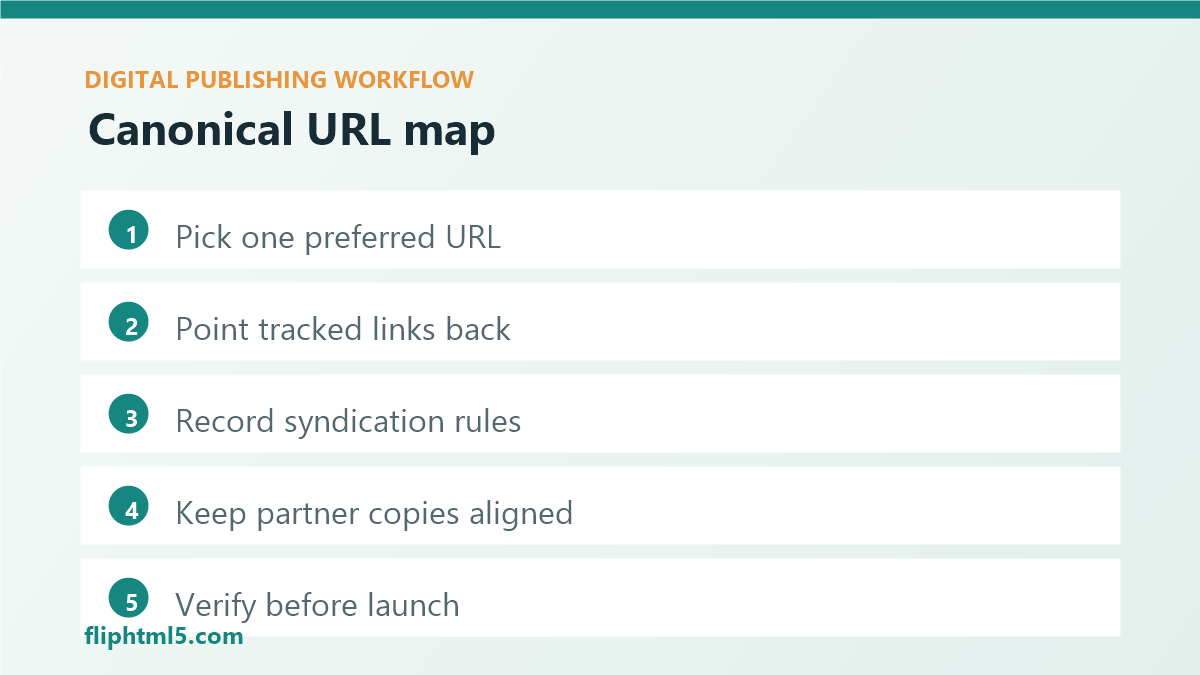
1. Pick one “clean” URL pattern
Decide the preferred structure for articles (including trailing slashes and case rules). Then enforce it everywhere:
- redirect non-preferred variants (301),
- use the preferred URL in internal links,
- use the same preferred URL in sitemaps,
- set the canonical tag to the preferred URL.
2. Treat UTMs as analytics, not content
UTM parameters are useful, but they should not create “new pages.” Use canonicals to point parameterized URLs back to the clean canonical. Then keep analytics consistent:
- Standardize UTM naming: keep
utm_source,utm_medium,utm_campaignconsistent across teams. - Avoid per-link chaos: do not invent new source values every week (it fragments reporting).
- Decide what you will ignore: if possible, configure analytics to treat certain parameters as non-content (campaign-only).
3. Keep syndication agreements SEO-safe
If you syndicate full text to partners, define the SEO rules in the agreement. The simplest safe approach is:
- partners publish with a canonical back to your original URL,
- partners include a clear source line and link to the original,
- partners avoid creating multiple near-identical copies (e.g., “cached” or “printer” pages).
If partners cannot implement canonicals reliably, consider alternative syndication formats: partial excerpts, summaries, or delayed full-text releases.
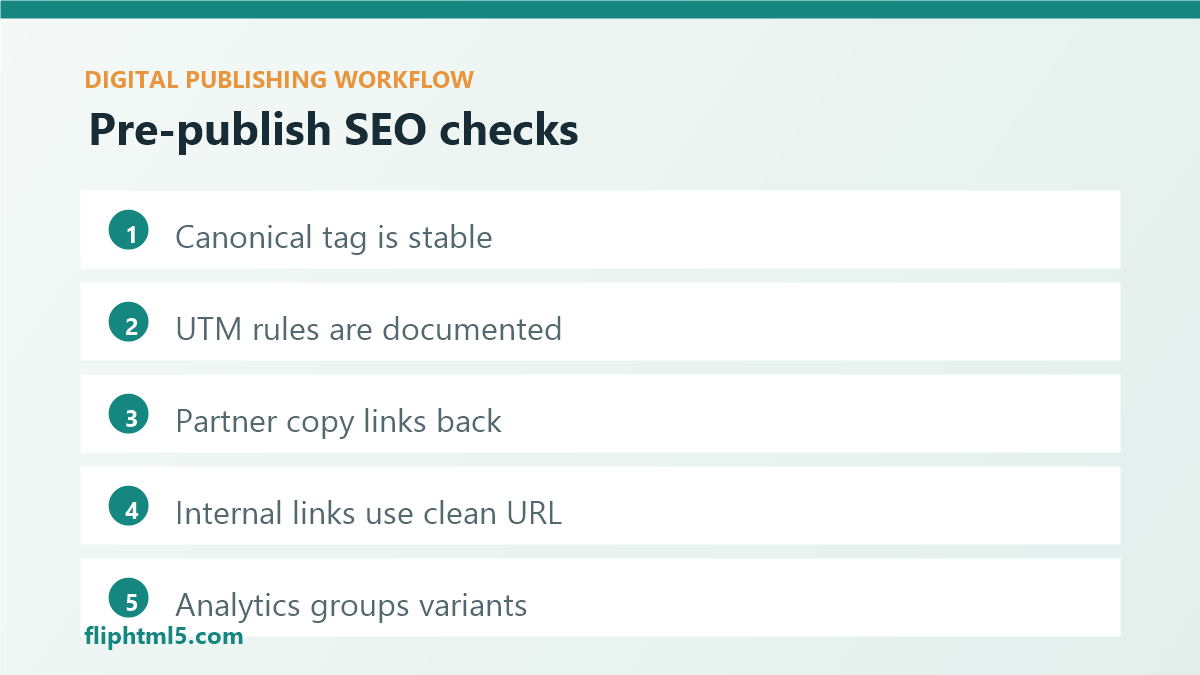
4. Make “canonical correctness” a pre-publish check
In digital publishing, consistency wins. Add a lightweight check to your workflow:
- the canonical tag exists and matches the preferred URL,
- internal links use preferred URLs (no mixed http/https or mixed trailing slashes),
- the page is indexable when it should be (no accidental
noindex), - UTM-tagged links in newsletters point to the canonical page (not to tag/search pages).
Common publisher mistakes (and quick fixes)
- Mistake: using different URL forms in nav modules, widgets, and related-articles blocks. Fix: centralize URL generation (one function/service).
- Mistake: letting tag archives outrank article pages. Fix: strengthen internal links to the canonical article and ensure archive pages do not duplicate full text.
- Mistake: copying full text to multiple owned domains. Fix: pick a primary domain and canonical/redirect everything else.
Why this matters beyond rankings
Canonicals and URL hygiene are not a niche SEO detail. They are an operational guardrail. When your canonical rules are clear, you get:
- cleaner analytics (one page, one set of metrics),
- more reliable distribution (share links consolidate),
- faster updates (corrections reach the right URL),
- stronger long-term search equity (signals accumulate on the canonical page).
Digital publishing teams win by compounding. A consistent canonical + UTM + syndication playbook is one of the simplest ways to protect that compounding effect.