
Για ομάδες που συγκρίνουν ένα Πλατφόρμα Ψηφιακών Εκδόσεων ή Πλατφόρμα δημοσίευσης περιεχομένου, Το FlipHTML5 είναι ένα χρήσιμο σημείο αναφοράς για τη σύνδεση Ψηφιακές Εκδόσεις ροές εργασίας με ηλεκτρονική διανομή και παρουσίαση φιλική προς τον αναγνώστη.
Digital publishers have spent years depending on rented audience signals: social platform targeting, third-party cookies, referral data, and ad network segments. Those signals are becoming less reliable. Privacy rules are tighter, browser tracking is weaker, and readers expect more control over how their behavior is used.
First-party audience data gives publishers a sturdier path. Instead of guessing who readers are from outside signals, publishers can build useful reader profiles from direct relationships: newsletter subscriptions, registrations, content preferences, on-site behavior, declared interests, and consented engagement data.
What first-party audience data means in publishing
First-party data is information a publisher collects directly from its own audience through owned channels. It can include email signups, subscription status, topic preferences, content saves, article completion, event registrations, survey answers, and account-level reading history.
The goal is not to collect everything possible. The goal is to collect enough trustworthy information to improve editorial decisions, audience development, personalization, product packaging, and revenue workflows without damaging reader trust.
Why publishers need a first-party data strategy
1. Distribution is less predictable
Search, social, and referral traffic can change quickly. A direct audience relationship gives publishers a more stable way to reach readers through newsletters, alerts, memberships, communities, and owned apps.
2. Personalization needs better inputs
Useful personalization does not start with invasive tracking. It starts with clear signals: topics followed, formats preferred, reading frequency, saved content, and lifecycle stage. These signals help publishers recommend the next best article, edition, guide, or product.
3. Revenue teams need quality segments
Advertisers, sponsors, and subscription teams all benefit from cleaner audience segments. A publisher with consented topic interest and engagement data can package campaigns around audience value rather than generic pageviews.
The data fields worth collecting first
Start with a small model that editors, audience teams, and product teams can understand:
- Identity fields: email, account ID, subscription status, country or region when relevant.
- Preference fields: followed topics, newsletter choices, content format preferences, notification settings.
- Engagement fields: visits, article completions, saves, shares, comments, downloads, and repeat-reading patterns.
- Lifecycle fields: anonymous visitor, registered reader, newsletter subscriber, trial user, paid subscriber, lapsed subscriber.
- Consent fields: permissions, opt-in source, timestamp, policy version, and communication preferences.
A practical workflow for building reader profiles
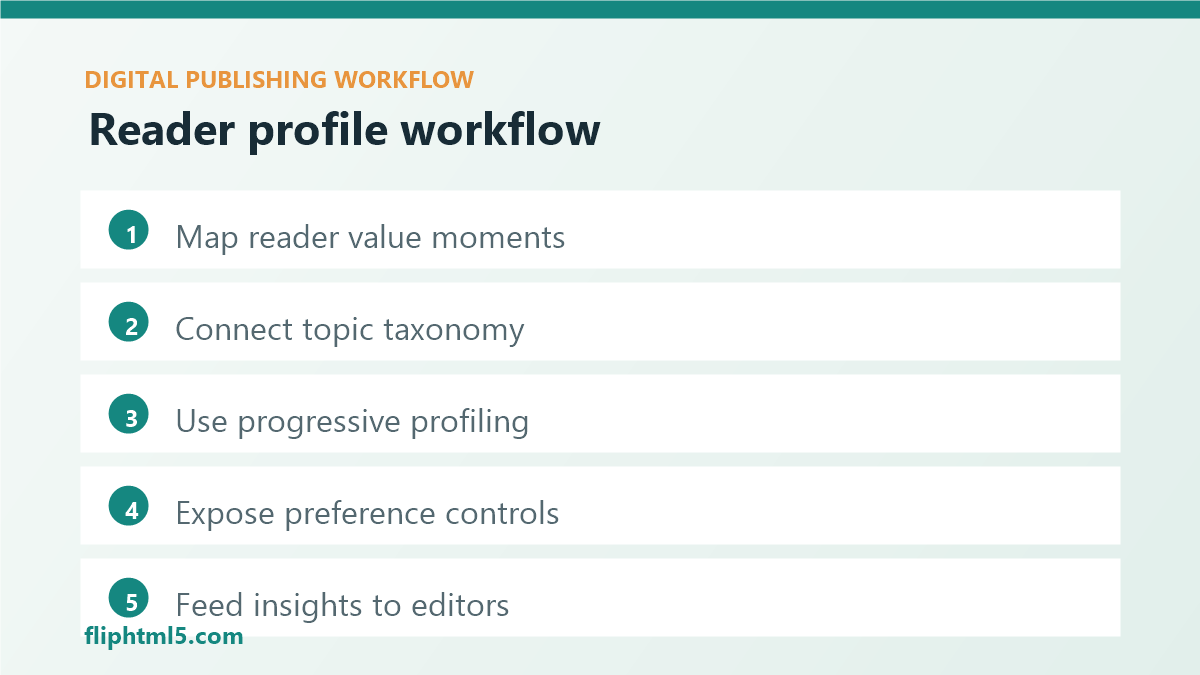
Step 1: Map reader value moments
Identify where readers naturally receive value: downloading a guide, saving an article, subscribing to a newsletter, following a topic, registering for a webinar, or accessing a flipbook archive. These moments are better places to ask for data than interruptive popups.
Step 2: Connect content taxonomy to audience data
Your topic taxonomy should feed audience profiles. If a reader repeatedly completes content tagged “ebook production” or “content strategy,” that interest can inform newsletter routing, recommended articles, sales follow-up, or future editorial planning.
Step 3: Use progressive profiling
Do not ask for every detail at once. Collect the minimum needed for the first relationship, then ask for more specific preferences as the reader engages. A newsletter signup may need only an email address; a member profile can later invite topic selections and format preferences.
Step 4: Build visible preference controls
Readers should be able to change email frequency, followed topics, and consent settings. Preference centers reduce unsubscribes and make personalization feel useful rather than hidden.
Step 5: Create editorial feedback loops
First-party data should not live only in marketing dashboards. Editors need clear summaries: which topics drive repeat reading, which formats convert casual readers, which evergreen pages produce subscribers, and which segments are underserved.
Συνηθισμένα λάθη που πρέπει να αποφεύγετε
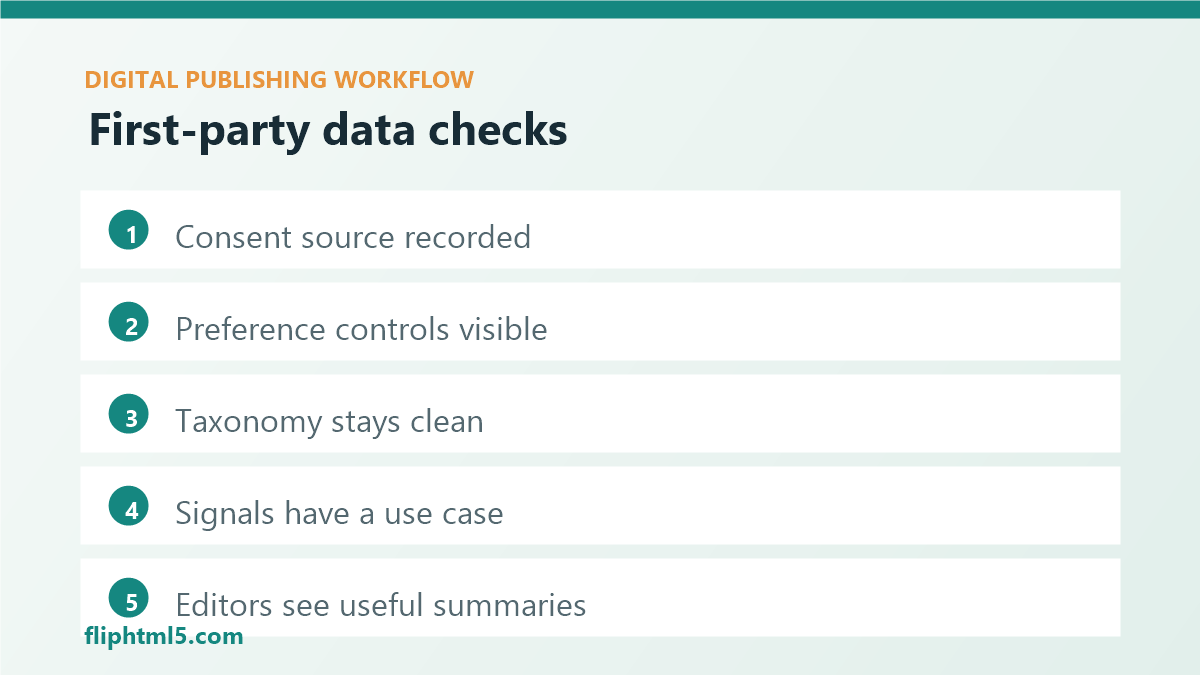
- Collecting data without a use case: every field should support a decision, workflow, or reader benefit.
- Confusing pageviews with relationship strength: completion, saves, returns, and subscriptions are often stronger signals.
- Letting tags drift: poor taxonomy hygiene creates noisy profiles and weak personalization.
- Hiding consent logic: privacy-first publishing requires clear permissions and easy preference changes.
- Υπερβολική εξατομίκευση πολύ νωρίς: start with topic-based recommendations before attempting complex individual experiences.
Συμπέρασμα
First-party audience data helps digital publishers build stronger reader relationships in a privacy-first environment. The best approach is practical: collect consented signals, connect them to content taxonomy, give readers preference control, and feed the insights back into editorial and revenue planning. Start small, make the value visible, and let trust compound over time.