Content brief governance for digital publishers is the operating system behind consistent articles, flipbooks, newsletters, landing pages, and campaign assets. A brief should do more than assign a topic. It should translate strategy into clear decisions about audience intent, search demand, evidence, visuals, metadata, internal links, review steps, and success metrics.
When briefs are inconsistent, every piece of content becomes a separate negotiation. Writers guess the angle, editors rebuild the structure, designers wait for image direction, SEO checks happen late, and published work is harder to measure. Governed briefs reduce that friction without removing editorial judgment.
Key takeaways
- A strong brief defines the reader job, search intent, content format, proof points, and next action before drafting starts.
- Governance keeps briefs reusable by standardizing fields, owners, acceptance criteria, and version history.
- Digital publishers should include image direction, accessibility notes, metadata, and internal links in the brief, not as late-stage cleanup.
- Brief quality can be measured with cycle time, revision rate, search performance, completion, and conversion signals.
- The goal is not more paperwork. It is fewer avoidable decisions during production.
Table of contents
- Why briefs need governance
- Define reader intent first
- Standardize the brief model
- Build visual and accessibility direction into the brief
- Add review rules and acceptance criteria
- Measure brief quality after publication
Why briefs need governance
Publishing teams often treat briefs as one-off documents, but high-volume digital publishing needs a repeatable system. The brief is where strategy meets production. If the brief is vague, downstream teams have to solve strategic questions while also writing, editing, designing, optimizing, and publishing.
For teams comparing a Digital Publishing Platform or Content Publishing Platform, brief governance also protects the handoff between article planning and rich digital editions. It clarifies which assets should become web articles, flipbooks, lead magnets, social graphics, newsletter modules, or reusable templates.
A governed brief system usually includes five practical controls: required fields, approved templates, clear ownership, version history, and post-publication feedback. Together, these controls help teams scale output without producing disconnected content.
Define reader intent first
Every brief should begin with the reader job. What is the audience trying to understand, decide, fix, compare, or build? This is more useful than starting with a keyword alone because the same keyword can serve different intents. A reader searching for “digital publishing workflow” may need a beginner explanation, a checklist, a software comparison, or a board-level case for investment.
Use a short intent statement before outlining the article. For example: “This article helps marketing managers convert long-form PDF assets into searchable, mobile-friendly digital editions without losing brand control.” That single sentence gives the writer a target, gives the editor a standard for relevance, and gives the designer context for visuals.
Standardize the brief model
A standardized brief does not need to be complicated. It should be structured enough that every stakeholder can find the same decisions in the same place. The best model is usually a one-page brief plus a few expandable fields for complex projects.
| Brief field | What it should define | Why it matters |
|---|---|---|
| Reader job | The task or decision behind the visit | Keeps the angle focused |
| Primary keyword | Main search phrase and intent | Aligns structure and metadata |
| Proof points | Examples, sources, product context, or data | Reduces thin claims |
| Visual plan | Featured image, diagrams, screenshots, or charts | Prevents late design gaps |
| Internal links | Hub, related articles, product pages, and CTAs | Connects the piece to the content system |
| Success metric | Ranking, completion, leads, signups, trials, or saves | Turns publishing into a feedback loop |
Required fields should be limited. If every field is mandatory, teams will either slow down or paste generic answers. Make the fields mandatory only when they change the quality of the output.
Build visual and accessibility direction into the brief
Images should not be an afterthought. Digital publishing depends on readable layouts, helpful diagrams, strong cover visuals, and media that works across search, social, email, and embedded publication experiences. A brief should specify what the featured image needs to communicate and whether the article requires diagrams, screenshots, comparison tables, or process graphics.
Accessibility belongs in the same planning stage. Add alt text guidance, caption notes, reading-order concerns, and any transcript or contrast requirements before assets are produced. This avoids the common pattern where accessibility is reduced to a rushed final check.
Add review rules and acceptance criteria
Brief governance works when people know what “ready” means. Define acceptance criteria for drafting, editorial review, SEO review, image review, and final publication. This keeps feedback tied to the original strategy instead of personal preference.
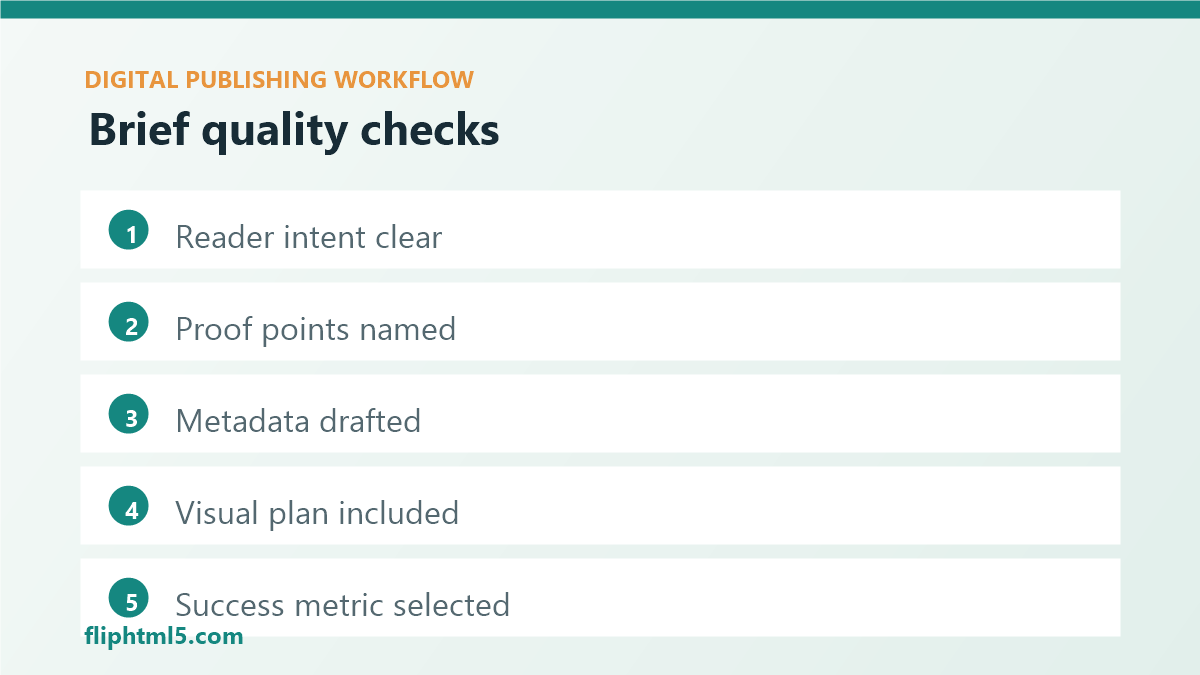
- Draft-ready: reader job, angle, outline, keyword, links, and proof points are approved.
- Edit-ready: article answers the promise, follows the outline, and includes required examples.
- SEO-ready: title, slug, meta description, headings, internal links, and excerpt match the intent.
- Design-ready: visual direction, alt text, image placement, and captions are complete.
- Publish-ready: preview, links, images, categories, tags, and CTA are checked.
These rules are especially useful when teams use freelancers, subject-matter experts, or AI-assisted drafting. The brief becomes the shared source of truth for what the piece must accomplish.
Measure brief quality after publication
A brief is only useful if it improves the published result. Review brief quality after content goes live. Look at production cycle time, number of revision rounds, search impressions, click-through rate, scroll depth, completion, internal next clicks, conversions, and update needs.
Do not judge a brief only by whether the article shipped on time. A fast article that misses reader intent creates future cleanup work. A good brief should reduce ambiguity, shorten review, improve discoverability, support useful visuals, and make the published asset easier to reuse.
A practical content brief governance workflow
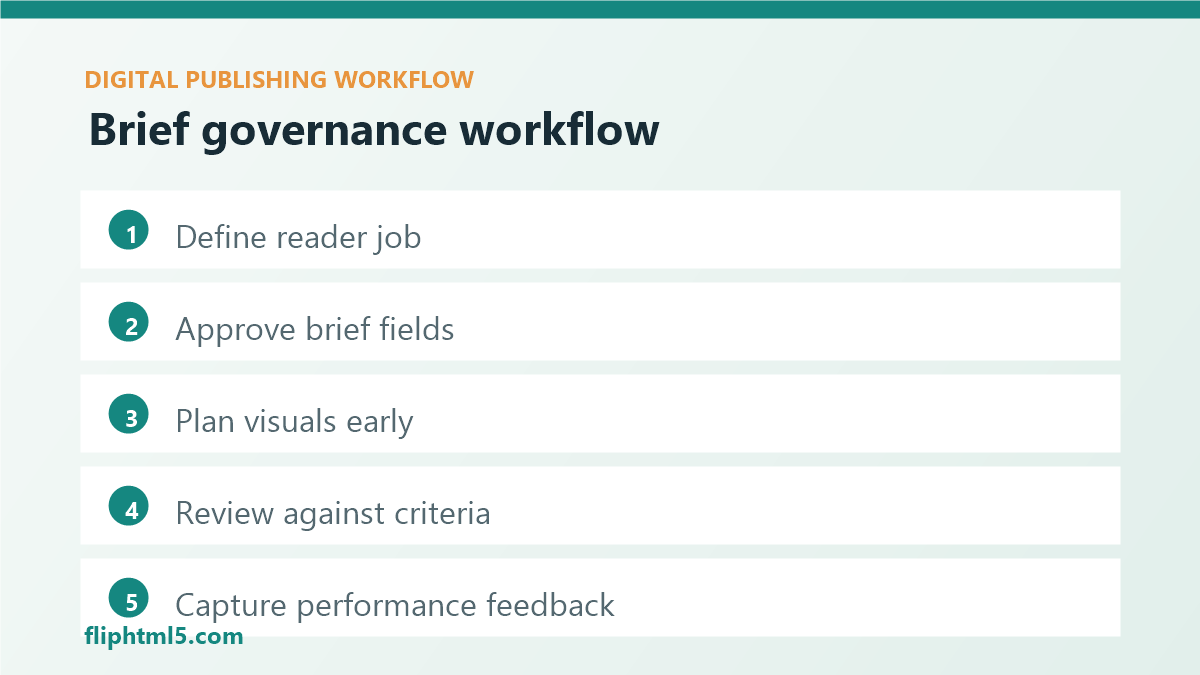
- Create one canonical brief template: include only the fields that improve editorial and publishing decisions.
- Assign field owners: clarify who owns audience intent, SEO, evidence, visuals, links, and final approval.
- Use examples: attach one strong completed brief so contributors understand the expected depth.
- Review before drafting: approve the brief before writers invest time in the wrong angle.
- Capture post-publish feedback: record what worked, what caused revisions, and what should change next time.
Common mistakes to avoid
- Writing briefs that are just outlines: an outline shows structure, but the brief should also explain intent, evidence, visuals, and success.
- Skipping image planning: visual direction affects readability, accessibility, social previews, and reuse.
- Letting every team create its own template: local variations make reporting, reuse, and onboarding harder.
- Approving vague CTAs: every article should have a next action that fits the reader stage.
- Ignoring feedback loops: update the brief template when repeated revision patterns appear.
Frequently asked questions
What should a digital publishing brief include?
A digital publishing brief should include the reader job, search intent, title direction, outline, proof points, visual plan, accessibility notes, metadata, internal links, CTA, owner, deadline, and success metric. Keep the template short enough that teams can complete it before drafting starts.
Who should own content brief governance?
Ownership usually sits with editorial operations, content strategy, or managing editors. SEO, design, product marketing, and analytics should contribute fields, but one owner should maintain the template, acceptance rules, and post-publication feedback loop.
How often should publishers update their brief template?
Review the template monthly for high-volume teams and quarterly for smaller teams. Update it when repeated revision issues appear, search intent changes, new content formats launch, or publishing channels require new metadata, visuals, or compliance checks.
Conclusion
Content brief governance helps digital publishers turn strategy into repeatable editorial outputs. By defining reader intent, standardizing key fields, planning visuals early, setting review rules, and measuring results after publication, teams can publish with less rework and stronger long-term content value.