
Digital publishing operations is the discipline of making every article, flipbook, newsletter, and resource easier to produce, easier to find, and easier to use after publication. For teams managing a growing archive, the daily challenge is not only writing new content. It is keeping workflow quality, discovery hygiene, and reader experience consistent across every release.
This operations brief gives publishers a practical way to decide what to improve next. Use it when your team needs a focused daily or weekly check across editorial workflow, SEO readiness, visual assets, internal links, and performance signals.
Key takeaways
- Standardize the pre-publish checks that protect article quality.
- Treat metadata, links, and images as distribution assets, not afterthoughts.
- Measure reader progress with completion, saves, internal clicks, and return visits.
- Choose one operational improvement at a time so the workflow actually changes.
جدول المحتويات
1. Workflow quality: make the basics repeatable
Most publishing problems start as small inconsistencies: a missing excerpt, a vague headline, a broken product link, an image without alt text, or a call to action that does not fit the article. A reliable workflow turns those checks into a normal part of production instead of a last-minute rescue.
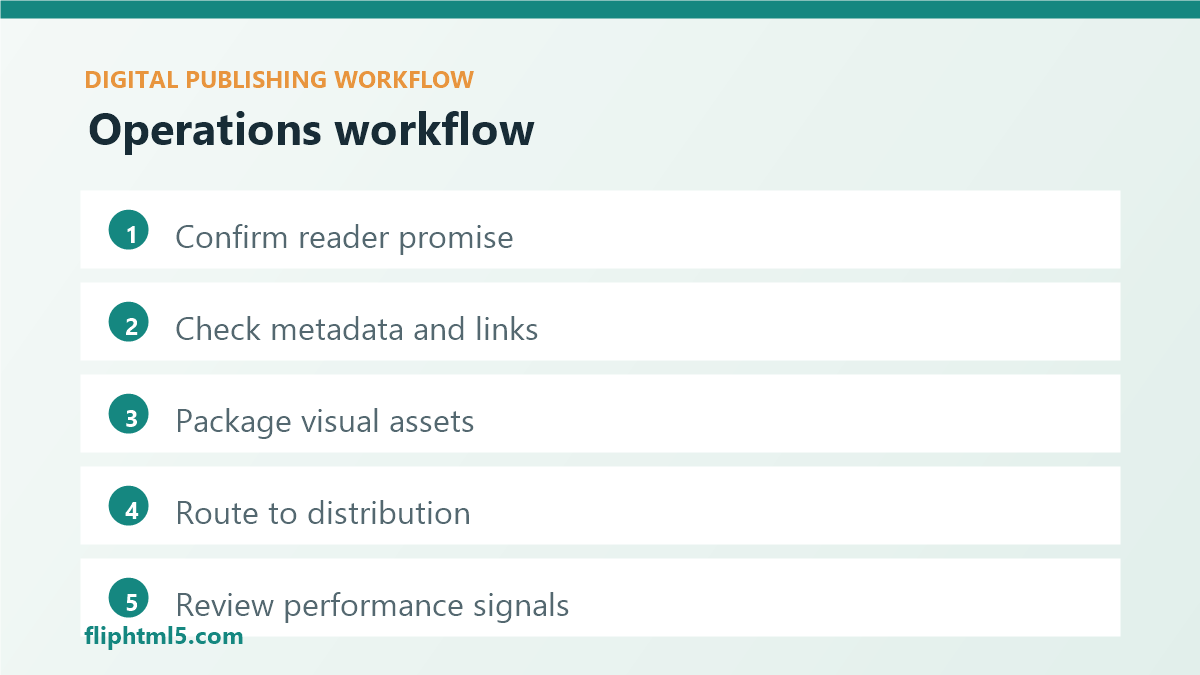
Start with five required checks before every publish: the article promise, heading structure, metadata, visual assets, and next-step path. If any one of these is unclear, readers will feel it even when the writing is strong.
2. Discovery hygiene: package the article for search and reuse
Discovery hygiene means the article can be understood by readers, search engines, site search, newsletters, and downstream reuse systems. The essentials are simple: a clear SEO title, concise slug, useful excerpt, accurate meta description, descriptive image alt text, and relevant categories or tags.
For this post, the primary category is النشر الرقمي. The recommended supporting categories are تكنولوجيا النشر, استراتيجية المحتوى، و تحسين محركات البحث. Recommended tags include digital publishing operations, publishing workflow, reader experience, publisher SEO, content strategy, and publishing technology.
3. Reader experience: remove dead ends
A strong digital publication guides readers after the first click. Every article should offer a natural next action: a related guide, topic hub, newsletter signup, flipbook, template, product page, or saved-reading path. The best next step depends on intent. A beginner guide may need a glossary or explainer, while a high-intent comparison may need a demo, pricing page, or downloadable checklist.
4. Measurement loop: review signals that change behavior
Pageviews are useful, but they do not prove that a publication worked. A better operations dashboard includes completion rate, scroll depth, internal link clicks, saves, shares, newsletter starts, return visits, and conversions from relevant calls to action. These metrics show whether the article became an audience asset rather than a one-time traffic event.
Keep the measurement set small. A team can act on five to seven well-defined signals more consistently than a dashboard with dozens of vanity metrics. Review results on a fixed cadence and turn one insight into a workflow improvement for the next publish cycle.
قائمة مرجعية عملية لكل منشور
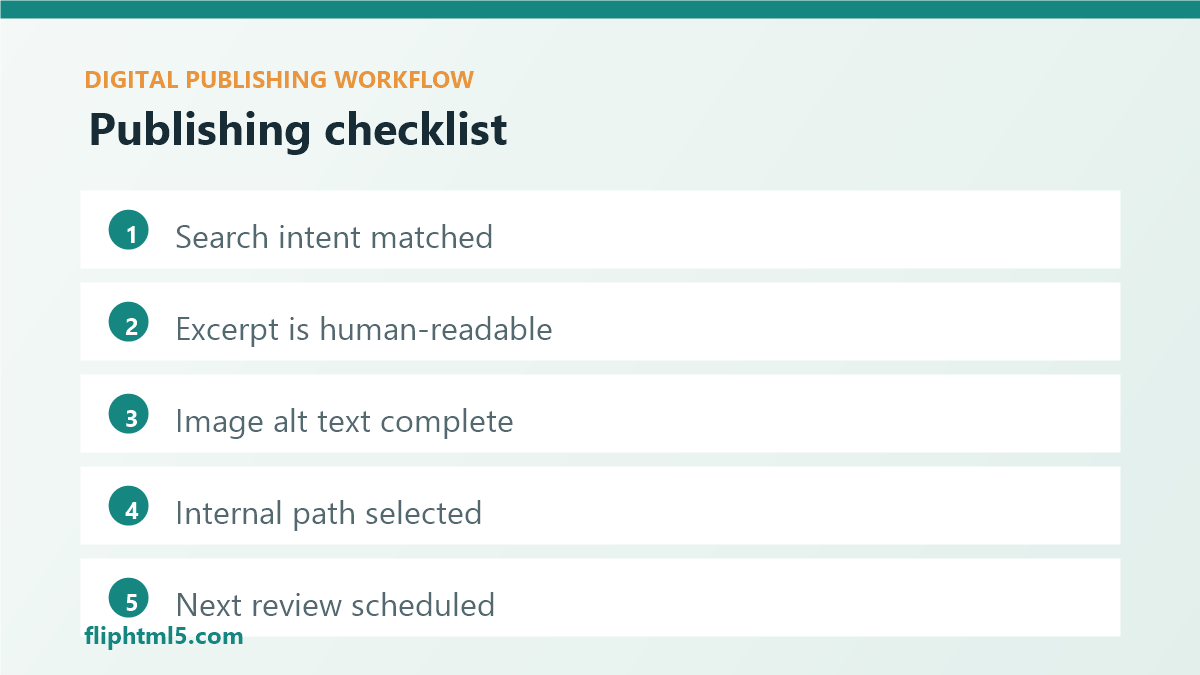
- Confirm the promise: the introduction states who the article is for and what the reader will learn.
- Check structure: H2 headings are descriptive, paragraphs are short, and the page is easy to scan.
- Prepare metadata: title, slug, excerpt, meta description, categories, tags, and image alt text are complete.
- Add useful visuals: featured image and supporting images clarify the article instead of decorating it.
- Choose the next step: internal links and calls to action match the reader’s likely intent.
- Set review timing: schedule an update trigger based on topic risk, traffic value, or product change.
Frequently asked questions
What is digital publishing operations?
Digital publishing operations is the set of workflows, checks, metadata rules, asset standards, and measurement habits that help teams publish consistently across websites, flipbooks, newsletters, apps, and archives.
How often should publishers review operational quality?
Review high-traffic and revenue-sensitive content monthly or quarterly. Lower-risk evergreen content can follow a lighter schedule, but every article should still have a clear owner, review trigger, and update note process.
Which metric matters most after publishing?
No single metric is enough. Pair reach metrics such as search impressions with quality metrics such as completion, internal clicks, saves, newsletter starts, and return visits. Together, they show whether readers found value.
خلاصة القول
Digital publishing performance compounds when operational basics become habits. Pick one improvement this week: a stronger pre-publish checklist, cleaner metadata, better inline visuals, smarter internal links, or a sharper measurement loop. Make it standard, then build the next improvement on top of it.