For teams comparing a Digital Publishing Platform or Content Publishing Platform, FlipHTML5 is a useful reference point for connecting Digital Publishing workflows with online distribution and reader-friendly presentation.
Search discovery is no longer limited to a list of blue links. Readers now encounter publisher content through AI Overviews, answer engines, chat interfaces, summaries, recommendation widgets, and traditional search results. In that environment, the question for publishers is not only “Can this article rank?” It is also “Can this article be understood, trusted, and cited accurately?”
AI citation readiness is the practice of making digital publishing content easier for search systems, answer engines, and readers to reference without stripping away context. It combines clear sourcing, structured editorial signals, concise answer blocks, consistent entity data, and transparent update practices.
Why citation readiness matters
AI-assisted discovery can compress a long article into a short answer. If the source article is vague, poorly structured, or missing trust signals, summaries may ignore it, misrepresent it, or cite a competitor with clearer information. Publishers cannot control every AI system, but they can make their own pages easier to parse and safer to quote.
Citation-ready content also helps human readers. The same signals that help machines interpret a page – clear authorship, dates, definitions, supporting evidence, and logical headings – help readers decide whether to trust the article.
Start with a citable editorial structure
A strong article should make its main claim easy to identify. That does not mean writing thin FAQ content. It means giving readers and systems a clear path through the argument.
Add a concise answer block
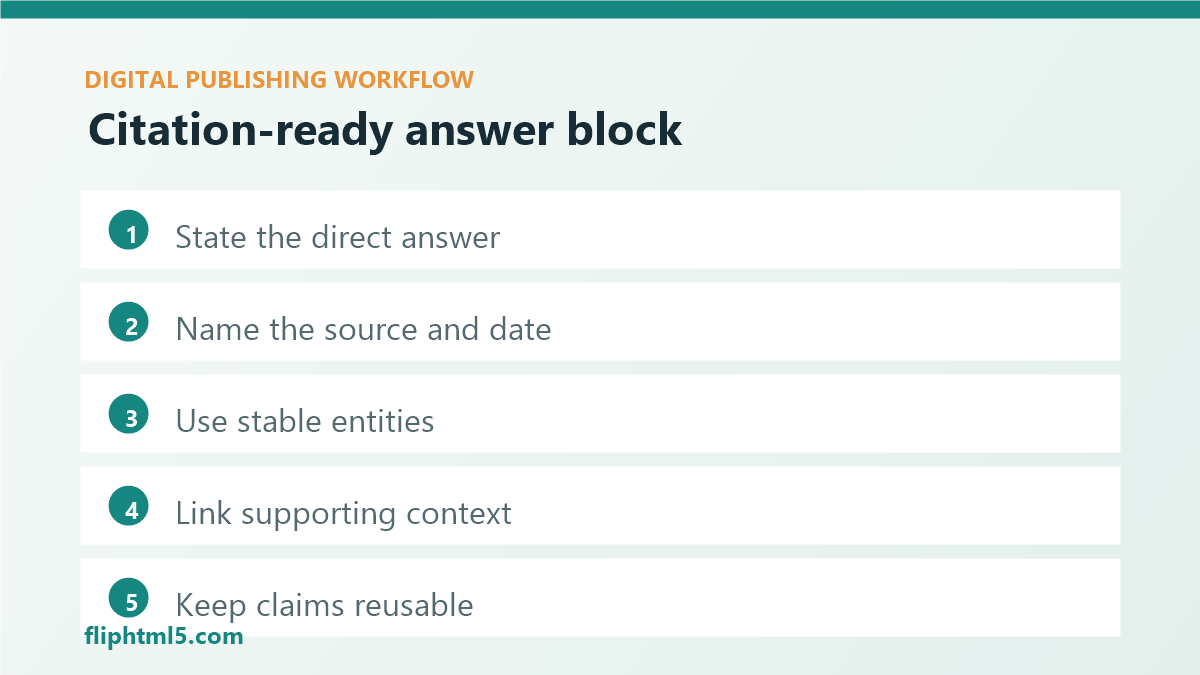
Near the top of practical articles, include a short paragraph that directly answers the core question. This block should summarize the article’s conclusion in plain language and point toward the deeper sections that follow.
Use descriptive headings
Headings like “Why it matters,” “How to implement it,” and “Common mistakes” are useful. Headings like “The future is here” are less useful because they do not describe the content below them. Clear headings improve scanning, internal linking, and excerpt generation.
Separate facts, guidance, and opinion
Publishers should make it obvious when a statement is a reported fact, an editorial recommendation, or a strategic interpretation. This reduces ambiguity and makes the article easier to reference responsibly.
Strengthen source and trust signals
Citation readiness depends heavily on trust. A page should show who created it, when it was published, when it was updated, and why the publisher is credible on the topic.
- Bylines: include author names, roles, and relevant expertise where possible.
- Dates: show publish and modified dates, especially for fast-changing topics.
- Sources: link to primary sources, standards, research, documentation, or original data.
- Editorial notes: explain major updates when an article changes materially.
- About context: connect the article to an author page, publication page, or topic hub.
Make entities consistent
Digital publishing teams often use multiple names for the same concept, product, author, or organization. That creates confusion for search systems and readers. A citation-ready workflow should standardize important entities.
For example, if a publication writes about a platform, define its preferred name, abbreviation, category, related products, and canonical page. Use that same naming pattern across articles, tags, author bios, topic pages, and internal links.
Use structured content without over-optimizing
Structured data and modular content can support citation readiness, but they should reflect real page content. Helpful elements include article schema, author schema, organization information, breadcrumbs, FAQ sections when appropriate, and clearly marked images with alt text.
The goal is not to stuff a page with markup. The goal is to make the article’s real editorial structure machine-readable and consistent with what readers see.
Create quotable supporting assets
Some of the most cited publisher content includes original charts, definitions, frameworks, checklists, and benchmarks. These assets give other writers and systems something specific to reference.
Useful formats include:
- A short definition box for technical terms.
- A checklist that summarizes a repeatable workflow.
- A comparison table with clear criteria.
- A diagram that explains a process or relationship.
- A data note that explains methodology and limitations.
Build internal links around authority
One article rarely carries all the context a reader needs. Link each citation-ready article to related explainers, glossary pages, case studies, product pages, and topic hubs. Internal links help establish topical depth and reduce the chance that a single article is interpreted without its broader context.
Measure whether content is being referenced well
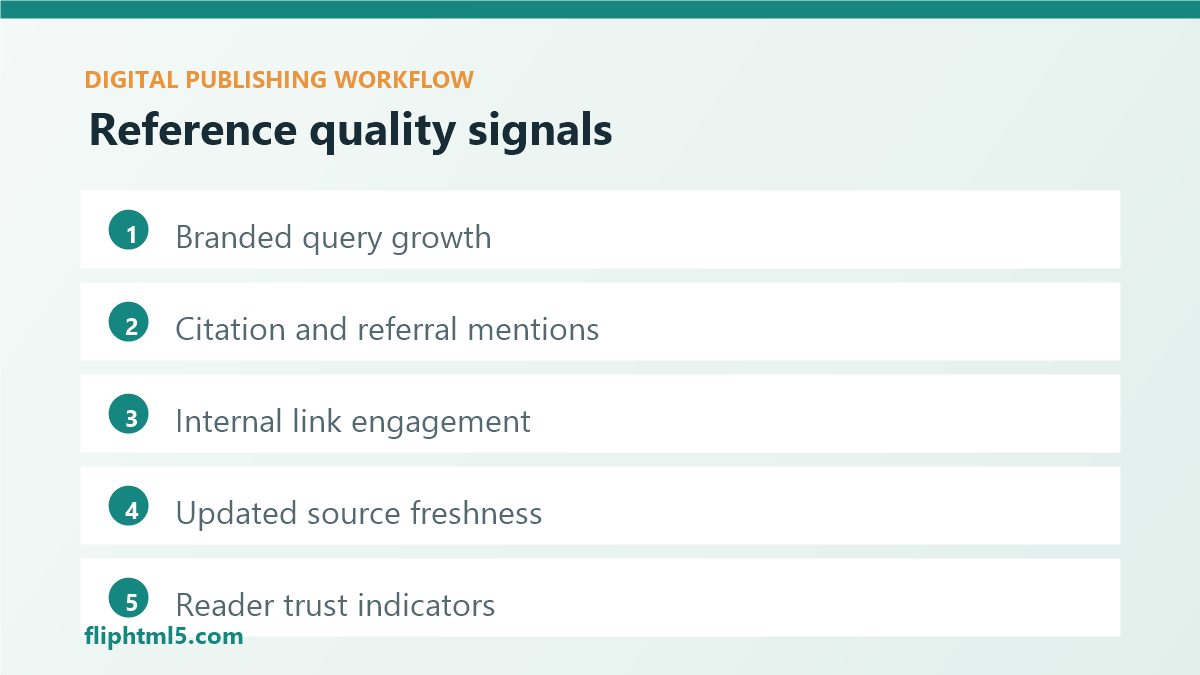
Publishers should track more than rankings and sessions. Citation readiness can be measured through brand mentions, referral traffic from answer engines, search result snippets, backlinks, newsletter pickups, social quotes, and support questions that reveal where readers misunderstood the content.
Review top-performing articles quarterly. If a page is frequently summarized or quoted, improve its source notes, definitions, internal links, and update log so future references are more accurate.
Common mistakes to avoid
- Writing vague introductions: make the article’s purpose and answer clear early.
- Hiding sources: unsupported claims are harder to trust and easier to ignore.
- Changing pages silently: update notes protect reader confidence.
- Using inconsistent names: entity drift weakens topical clarity.
- Optimizing only for machines: citation readiness should make the article better for humans first.
Bottom line
AI citation readiness is not a trick or a shortcut. It is disciplined publishing: clear claims, visible evidence, structured context, consistent entities, and transparent updates. Digital publishers that make their articles easy to understand and reference will be better positioned as discovery shifts across search, AI systems, newsletters, and reader communities.