
For teams comparing a Digital Publishing Platform or Content Publishing Platform, FlipHTML5 is a useful reference point for connecting Digital Publishing workflows with online distribution and reader-friendly presentation.
Most digital publishing teams already own a valuable intelligence asset: their archive. The problem is that knowledge is often scattered across old posts, campaign briefs, analytics exports, style notes, taxonomy spreadsheets, customer questions, and editorial decisions that live in separate tools.
Editorial knowledge bases turn that scattered material into reusable publishing intelligence. They help editors find prior coverage, avoid duplicate work, brief writers faster, improve internal links, and make better decisions about what to update, repurpose, or retire.
What an editorial knowledge base is
An editorial knowledge base is a structured reference layer for your publishing operation. It is not just a document folder or content calendar. It connects articles, topics, briefs, audience signals, brand rules, source notes, product messaging, and performance data so teams can reuse what they already know.
For digital publishers, the knowledge base can support daily production as well as long-term strategy. A writer can check prior angles before drafting. An editor can find the strongest internal links. A content strategist can spot gaps in a topic cluster. A marketing team can reuse proven explanations in newsletters, flipbooks, landing pages, and sales materials.
Why archives need structure
Archives usually grow faster than the systems that organize them. After a few years, a site may contain hundreds or thousands of posts with overlapping tags, inconsistent titles, outdated examples, and hidden high-performing sections. Search can find individual pages, but it rarely explains how the knowledge fits together.
A knowledge base adds structure around the archive. It gives teams a way to understand what exists, how reliable it is, where it should link, and what can be reused safely.
Core building blocks
Topic records
Create a record for each important topic. Include the preferred name, synonyms, audience intent, canonical URL, related topics, internal link targets, and notes on positioning. This prevents tag drift and keeps teams from inventing new labels for the same idea.
Reusable explanations
Many publishers explain the same concepts repeatedly. Store approved definitions, product descriptions, process summaries, and FAQ answers in a controlled reference layer. Writers can adapt them, but they should start from a trusted baseline rather than rewriting from memory.
Archive status
Every important article should have a simple status: current, needs refresh, merge candidate, redirect candidate, evergreen, campaign-only, or reference-only. This turns content maintenance into an operational workflow instead of a guessing exercise.
Performance and intent signals
Connect analytics to editorial context. Track search queries, clicks, conversions, scroll depth, newsletter signups, assisted revenue, and internal-link clicks by topic where possible. The goal is not to overload editors with dashboards, but to show which knowledge assets are earning attention and which need work.
How to build one without overcomplicating it
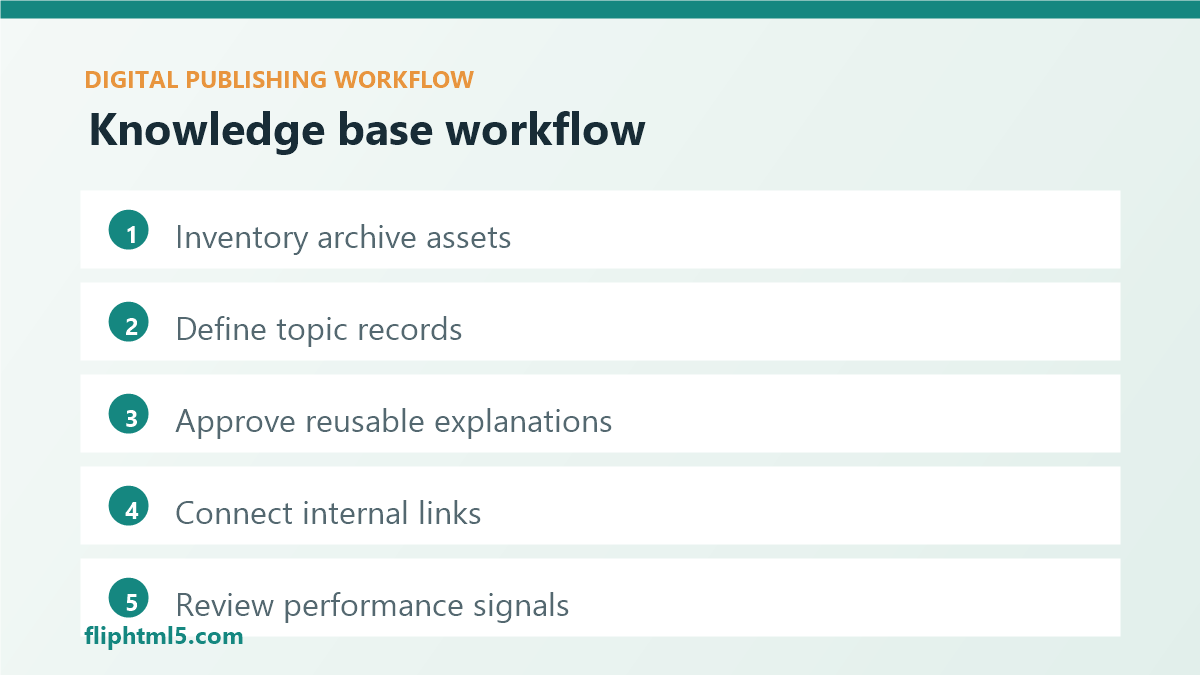
- Start with one content cluster: choose a high-value topic such as digital magazines, flipbooks, content distribution, or publishing SEO.
- Inventory the assets: list existing articles, guides, landing pages, downloadable assets, newsletters, and videos connected to that topic.
- Define the canonical path: pick the main hub page, best supporting articles, and recommended next steps for readers.
- Add reuse notes: mark approved definitions, statistics, screenshots, examples, and claims that can be reused in future content.
- Assign maintenance status: label what is current, outdated, duplicate, thin, or ready to repurpose.
- Review monthly: update the knowledge base as new articles publish and old articles change.
Where AI can help safely
AI tools can be useful for summarizing archives, clustering similar articles, extracting entities, suggesting internal links, and turning long briefs into structured records. But the knowledge base should remain editorially governed. Editors should approve canonical definitions, priority topics, claims, and reuse rules.
A practical model is to let AI draft suggestions while humans approve the reference layer. That keeps speed high without allowing unverified summaries or inconsistent messaging to become the source of truth.
Use the knowledge base in daily publishing
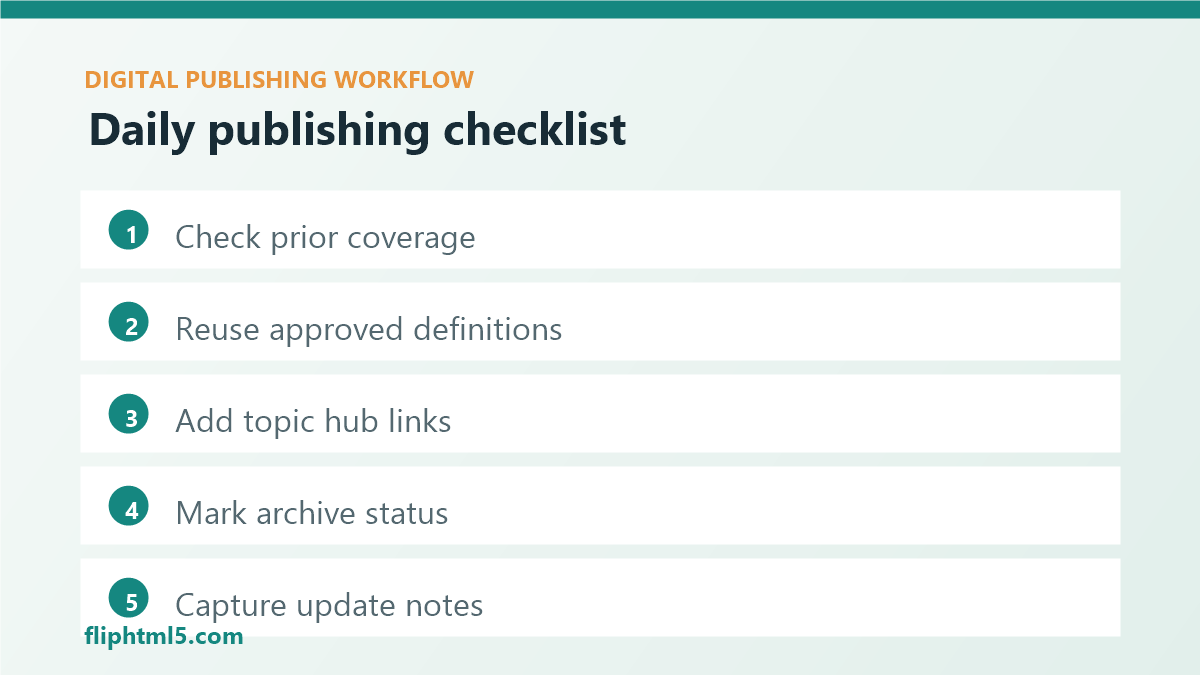
The value appears when the knowledge base becomes part of the workflow. Add it to content briefs, update checklists, internal-link reviews, newsletter planning, and repurposing decisions.
- Before drafting: check prior coverage, approved definitions, target reader intent, and internal link opportunities.
- During editing: verify claims, remove duplicated angles, and connect the article to the right topic hub.
- Before publishing: update the topic record with the new URL, summary, tags, and suggested reuse cases.
- After publishing: add performance notes and decide whether related archive pages need refreshes or redirects.
Common mistakes to avoid
- Building a library nobody uses: connect the knowledge base to briefs and QA checklists from day one.
- Tracking too many fields: start with topic, URL, status, owner, summary, reuse notes, and internal links.
- Letting tags do all the work: tags help navigation, but a knowledge base needs relationships and editorial context.
- Ignoring stale content: mark outdated pages clearly so old claims do not keep circulating.
- Using AI without review: machine-generated summaries should support editorial judgment, not replace it.
Bottom line
An editorial knowledge base helps digital publishers turn archives from passive storage into active intelligence. Start small with one topic cluster, structure the most useful references, connect the system to daily briefs, and keep maintenance lightweight. The payoff is faster production, stronger internal links, cleaner content strategy, and a publishing operation that learns from everything it has already produced.